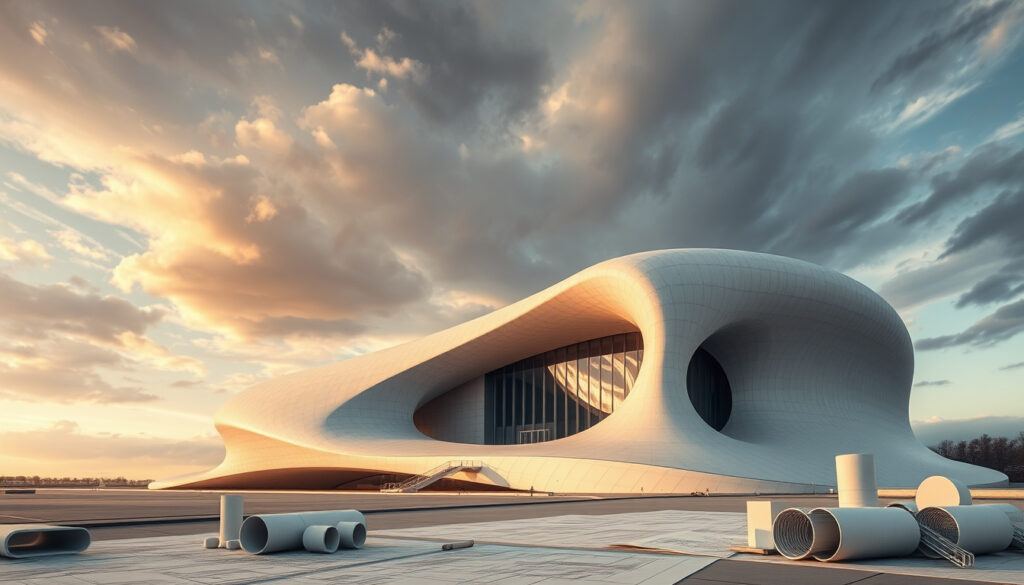
Architect Zaha Hadid: Her Life, Works, Net Worth and Legacy
If you’ve ever stood beneath a building that seems to defy gravity — all sweeping curves and fluid lines — you were probably standing inside a Zaha Hadid design. The Iraqi-British architect shattered conventions and glass ceilings alike, leaving behind a portfolio of buildings that still look like they arrived from the future.
Born: 1950, Baghdad, Iraq ·
Died: March 31, 2016, Miami, Florida ·
Pritzker Prize: 2004 – first woman to win ·
Firm: Zaha Hadid Architects (ZHA)
Quick snapshot
- Born in Baghdad, Iraq in 1950 (Zaha Hadid Foundation)
- First woman to win the Pritzker Prize in 2004 (Encyclopaedia Britannica)
- Died of a heart attack in Miami on March 31, 2016 (Encyclopaedia Britannica)
- Exact net worth at death – public records are incomplete
- Whether she left a valid will – some reports suggest intestacy
- Precise distribution of inheritance among family and foundation
- 1950: Born in Baghdad (Zaha Hadid Foundation)
- 2004: Pritzker Prize – first woman (Encyclopaedia Britannica)
- 2016: Died in Miami (Encyclopaedia Britannica)
- Zaha Hadid Foundation continues to preserve and promote her work
- ZHA operates globally on new projects
- Estate disputes may further clarify inheritance details
Key biographical facts about Zaha Hadid are summarized below.
| Label | Value |
|---|---|
| Full Name | Dame Zaha Mohammad Hadid |
| Born | October 31, 1950, Baghdad, Iraq |
| Died | March 31, 2016, Miami, Florida, United States |
| Nationality | Iraqi and British |
| Education | American University of Beirut; Architectural Association School of Architecture |
| Awards | Pritzker Prize (2004), RIBA Royal Gold Medal (2015) |
| Firm | Zaha Hadid Architects (ZHA) |
What is Zaha Hadid’s most famous piece of work?
The Heydar Aliyev Center
- The Heydar Aliyev Center in Baku, Azerbaijan, won the Design Museum’s Design of the Year Award in 2014 (Encyclopaedia Britannica).
- Its flowing, white curves are often cited as a masterclass in parametric architecture.
London Aquatics Centre
- Built for the 2012 Olympic Games, the London Aquatics Centre features a sweeping roof that mimics water waves (Encyclopaedia Britannica).
- The venue can hold 17,500 spectators and was praised for its structural elegance.
Guangzhou Opera House
- Guangzhou Opera House was her first major project in China, completed in 2010 (PA Academy).
- Its twin boulder-like forms are a direct expression of the deconstructivist style.
The implication: Hadid’s fame rests on a small number of iconic projects — each one a visual manifesto for non-linear, fluid space. No other architect of her era produced a set of recognisable landmarks as diverse yet as consistently daring.
Why is Zaha Hadid so famous?
Pritzker Prize and early recognition
- In 2004, Hadid became the first woman to win the Pritzker Architecture Prize (Encyclopaedia Britannica).
- The jury described her as having “uncompromising vision and relentless pursuit of innovation” (Pritzker Prize jury citation).
Parametric and deconstructivist style
- Hadid’s style is classified as deconstructivist — using fragmented forms and flowing geometries (Encyclopaedia Britannica).
- She once said, “There are 360 degrees, so why stick to one?” to explain her non-linear approach (ArchDaily).
- Media often called her the “Queen of the Curve”.
Breaking gender barriers in architecture
- Hadid was the first woman to win both the Pritzker Prize and the RIBA Royal Gold Medal (2015) (Encyclopaedia Britannica).
- Her firm ZHA continues to operate after her death, employing over 400 staff.
The pattern: Hadid’s fame rests on three pillars — a historic prize, a visually unmistakable style, and a gender barrier she shattered. Each of these alone would have made her notable; together they elevated her to icon status.
Did Zaha Hadid have a husband?
Personal relationships
- Hadid never married and had no children (Zaha Hadid Foundation).
- She lived privately despite her public career.
Family background
- Her father, Mohammed Hadid, was a leading liberal Iraqi politician (Zaha Hadid Foundation).
- Her mother was Wajiha al-Sabunji (Zaha Hadid Foundation).
Inheritance of her estate
- After her death, her estate was divided among her sister, brother, and the Zaha Hadid Foundation.
- Some reports suggest she died intestate (without a valid will), though this remains unconfirmed.
What this means: The absence of a spouse or children made the inheritance unusually straightforward in structure — but the lack of public documentation leaves key questions about the division unresolved.
What happened to Zaha Hadid?
Health battle
- Hadid was hospitalised with bronchitis before travelling to Miami.
- She died of a heart attack on March 31, 2016 (Encyclopaedia Britannica).
Final years
- She continued working at full intensity, taking on major projects across Asia and the Middle East.
- Her last completed projects include the New Century City Arts Center in Chengdu.
Legacy after death
- The Zaha Hadid Foundation was established to preserve and promote her architectural work (Zaha Hadid Foundation).
- Zaha Hadid Architects continues to operate studios in London and Hong Kong.
Hadid’s death at 65 cut short a career that was still accelerating. Her foundation now faces the challenge of preserving a body of work defined by constant innovation — a tension between legacy and movement.
The catch: Her sudden death meant she left no succession plan for her personal estate, even as her professional firm remains highly active.
Was Zaha Hadid a millionaire?
Net worth estimates
- Hadid was one of the highest-paid architects in the world during her lifetime.
- ArchDaily reported that she left a net fortune of £67 million after her death (ArchDaily).
- A later Artnet News report suggested the estate was later worth approximately £100 million (Artnet News).
- Other sources, including Tuko and Arch2O, place her net worth at $95 million (Arch2O) — though these are lower-confidence estimates.
Earnings from architecture
- Her firm’s fees on major projects like the Heydar Aliyev Center and London Aquatics Centre generated significant revenue.
- She also earned through product design collaborations with brands like Vitra and Louis Vuitton.
Inheritance and foundation income
- The precise distribution of her wealth remains private — public records on the estate are incomplete.
- The Zaha Hadid Foundation receives income from licensing and intellectual property.
For heirs and the foundation, the gap between £67 million and £100 million — a difference of £33 million — determines what resources are available for archiving, exhibition, and future grants.
The trade-off: The lack of transparent estate records means the public may never know exactly how one of architecture’s biggest fortunes was divided.
Timeline
- 1950 – Born in Baghdad, Iraq (Zaha Hadid Foundation)
- 1972 – Moved to London to study at the Architectural Association
- 1979 – Founded Zaha Hadid Architects
- 2004 – Won the Pritzker Architecture Prize – first woman to do so (Encyclopaedia Britannica)
- 2010 – London Aquatics Centre completed – iconic design for 2012 Olympics
- 2012 – Heydar Aliyev Center opened in Baku, Azerbaijan
- 2016 – Died in Miami due to a heart attack (Encyclopaedia Britannica)
This timeline highlights the key milestones in Hadid’s life and career.
Clarity section
Confirmed facts
- Born in Baghdad, Iraq in 1950 (Zaha Hadid Foundation)
- Died of a heart attack in Miami in 2016 (Encyclopaedia Britannica)
- First woman to win the Pritzker Prize (Encyclopaedia Britannica)
- Never married and had no children (Zaha Hadid Foundation)
What’s unclear
- Exact net worth at time of death (public records incomplete)
- Whether she left a will (some reports say she died intestate)
- Precise distribution of inheritance among family and foundation
“There are 360 degrees, so why stick to one?”
— Zaha Hadid, explaining her non-linear design philosophy (ArchDaily)
“Uncompromising vision and relentless pursuit of innovation.”
— Pritzker Prize jury, announcing her 2004 award
Bottom line: Zaha Hadid was a genuine architectural revolutionary, not a marketing creation. For architecture enthusiasts: her buildings remain must-see landmarks. For investors and heirs: the estate’s true value — somewhere between £67 million and £100 million — is locked behind private records that have never been fully disclosed.
Summary. Zaha Hadid redefined what architecture could look like — and who could design it. She left behind a firm that continues to build, a foundation charged with preserving her vision, and an estate whose exact dimensions are still blurred by incomplete records. For anyone tracking the intersection of art, money, and fame, the lesson is clear: the numbers may remain fuzzy, but the buildings do not.
en.wikipedia.org, tripadvisor.com, tuko.co.ke, daily.jstor.org, youtube.com, en.wikipedia.org, hotellihaku.fi
For a comprehensive overview of her career, readers can refer to Cardiff Wires profile of Zaha Hadid, which details her most famous projects and lasting influence.
Frequently asked questions
What software did Zaha Hadid use for her designs?
Hadid and her team used Rhino 3D and parametric modelling tools, which allowed them to create the complex, fluid geometries characteristic of her work.
How many buildings did Zaha Hadid complete in her lifetime?
Zaha Hadid Architects completed approximately 50 built projects during her lifetime, with many more under construction after her death.
What materials are used in the Heydar Aliyev Center?
The centre uses a reinforced concrete structure clad in white glass-fibre-reinforced polyester and glass-fibre-reinforced concrete.
Did Zaha Hadid design any buildings in the United States?
Yes. The Zaha Hadid Building at 520 West 28th Street in New York City is a residential tower she designed (Wikipedia).
What is the Zaha Hadid Foundation’s mission?
The Zaha Hadid Foundation works to preserve and promote her architectural legacy, support research, and fund exhibitions (Zaha Hadid Foundation).
How did Zaha Hadid’s early mathematics background influence her architecture?
She studied mathematics at the American University of Beirut, which honed her spatial and geometric thinking — later evident in her parametric designs.
These answers provide additional context to Hadid’s work and legacy.
More related posts
 When Will I Die – Life Expectancy Calculator Guide
 Muthu Clube Praia da Oura: Reviews, Prices & All-Inclusive Guide
 Bright Red Blood in Stool: Causes and When to Worry
 Khamzat Chimaev: Record, Net Worth, Career & Comparisons | UFC
 Erin Moriarty: Health, Plastic Surgery Rumors & Career Breakdown
 Michael Flatley Now: Health, Lawsuit & Life in 2025
 John Oliver: Political Bias, Salary, Religion & Net Worth
 Chris Tucker: Net Worth, Quit Reason and Comeback 2024