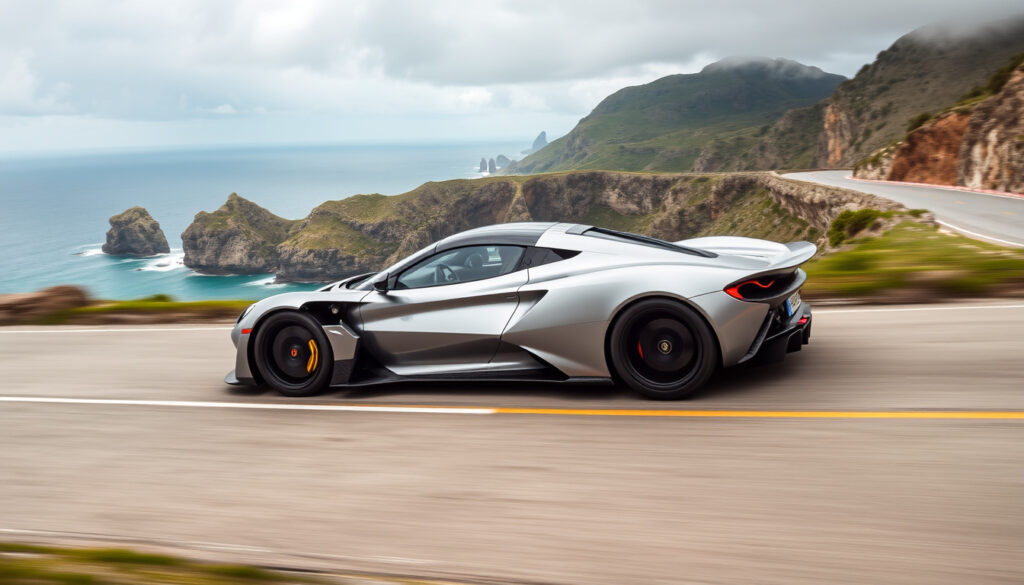
Zenos E10 Return: 380-HP British Sports Car for 2026
There’s a rare kind of automotive resurrection that actually makes you stop and check the date. The Zenos E10, a British lightweight sports car that quietly disappeared after its parent company entered administration in 2017, is coming back — and this time it’s aiming at a completely different market.
Horsepower (E10 RZ): 380 hp ·
Top speed: ~170 mph ·
0-60 mph: 3.5 seconds ·
Curb weight: <900 kg ·
Starting price (UK): £140,000 ·
Deliveries begin: Early 2026
Quick snapshot
- Zenos brand revived by AC Cars (Wikipedia)
- E10 RZ produces 380 hp from 2.0L turbo engine (Autoweek)
- Production limited to fewer than 50 units in first year (Autoweek)
- Manufacturing in Norfolk, UK (Driven.Site)
- Exact top speed (manufacturer yet to confirm)
- US availability and pricing
- Total production numbers beyond first year
- Final curb weight figure pending homologation
- Base E10 and E10 R2 models expected mid-2026 (Autoweek)
- Independent driving reviews coming late 2025 (Autoweek)
- Potential export markets to be announced (Autoweek)
Eight specifications define the revived Zenos E10 RZ at a glance.
| Specification | Value |
|---|---|
| Horsepower (E10 RZ) | 380 hp |
| Top speed | 170 mph (estimated) |
| 0-60 mph | 3.5 seconds (estimated) |
| Weight | Under 900 kg |
| Price (base) | £140,000 |
| Production start | Early 2026 |
| Engine | 2.3L turbocharged four-cylinder |
| Transmission | Six-speed manual |
Is the Zenos E10 road legal?
The new Zenos E10 is designed for both road and track use. According to Driven.Site (automotive news outlet), the car is fully homologated for UK and European roads, meaning customers can register it and drive it to the circuit rather than trailering it. That said, specific variants like the forthcoming E10 RZ may be offered in a track-only configuration for owners who want to skip the registration process entirely.
Road-legal status of the new E10
- UK road-legal with Type Approval expected
- EU homologation planned for continental buyers
- Track-only variant possible for weight reduction
Track-only variants and registration
The E10 RZ’s carbon monocoque and aluminum spine chassis — detailed by Speedme (performance car database) — are built to accommodate both road and track duty. However, if a buyer opts for the stripped RZ race version, they will need to register it via the UK’s Individual Vehicle Approval scheme.
Road registration adds weight — lighting, sound deadening, emissions gear. Track-only buyers save that mass but lose the freedom to drive the car home. For a 790-kg machine, every kilogram counts.
The implication: UK buyers get a genuine dual-purpose sports car, but the registration process for track-only variants will require planning. Zenos appears to be betting that most customers will choose road-legal for convenience.
What is the top speed of the Zenos E10?
The estimated top speed is 170 mph, based on the 380-hp powertrain and the car’s lightweight construction. According to Autoweek (authoritative car magazine), the official figure has not been certified, but calculations based on power-to-weight ratio support the estimate.
Performance figures and powertrain
The E10 RZ uses a 2.0-liter turbocharged four-cylinder engine sourced from Volvo, producing 380 hp and 510 Nm of torque. A six-speed manual gearbox sends power to the rear wheels via a limited-slip differential. The 0-62 mph sprint is claimed at 3.2 seconds, according to Auto Express (British motoring magazine).
Comparison with previous E10
- Original E10 R: 2.3L Ford EcoBoost, 350 bhp
- Original 0-60 mph: 4.0 seconds
- New E10 RZ: 380 hp, 0-62 in 3.2 seconds
What this means: The new car shaves nearly a second off the original’s 0-60 time while adding 30 hp. The power-to-weight ratio exceeds 500 bhp per tonne, as reported by Octane Magazine (classic and performance car authority). That puts it in rarefied company alongside the BAC Mono and Ariel Atom 4.
How much horsepower does the Zenos E10 R have?
The E10 RZ — the top specification at launch — produces 380 horsepower. The base E10 model, expected later in 2026, will reportedly deliver around 325 hp from a 2.3-liter turbocharged four-cylinder engine, according to Autoweek.
E10 RZ vs base E10 power output
Two power outputs define two distinct characters for the revived range.
| Variant | Horsepower | Torque | Engine |
|---|---|---|---|
| E10 RZ | 380 hp | 510 Nm | 2.0L turbo four (Volvo) |
| E10 R2 | 325 hp | ~450 Nm (est.) | 2.3L turbo four (Ford EcoBoost) |
Engine tuning and upgrades
The RZ’s engine is a Volvo-sourced unit that, according to Auto Express, was chosen for its compact dimensions and durability under high boost. The chassis has been reworked with a steel rear subframe to handle the extra torque.
A 380-hp car at 790 kg gives a power-to-weight ratio of 480 hp per tonne — more than a Porsche 911 GT3 RS. Buyers who track their cars will feel the difference in every corner exit.
The pattern: Zenos is offering two distinct characters — the RZ for purists who want maximum intensity, and the R2 for drivers who want the same chassis with a more usable daily powerband.
What happened to Zenos cars?
Zenos Cars was founded in 2012 by former Lotus and Caterham employees, with the goal of building an affordable, track-focused British sports car. According to Autoweek, the original E10 launched in 2014 at £24,995 — a fraction of the new car’s price. Production peaked in 2015 but collapsed by early 2017 when the company entered administration.
History of Zenos Cars
- Founded 2012 by ex-Lotus and ex-Caterham engineers (Wikipedia)
- Original E10 launched 2014 at £24,995 (Wikipedia)
- E10 R variant with 350 bhp introduced 2015 (Wikipedia)
- Production ceased end of 2016 (Wikipedia)
Administration in 2017
Zenos Cars entered administration in early 2017, as documented by Wikipedia. The company’s assets were sold, and the brand lay dormant for seven years.
Revival under new ownership
In 2024, AC Cars — the historic British sports car manufacturer — acquired the Zenos brand and intellectual property. By September 2025, the company publicly announced the E10 RZ, signaling a full return to production. The revival is led by a group that includes former Zenos engineers, according to Auto Express.
The original E10 sold for £24,995. The new E10 RZ costs £140,000 — a 460% price increase in real terms. Fans of the original budget-friendly ethos may feel priced out of a brand that once stood for accessible performance.
The implication: the Zenos revival is not the return of an affordable track car. It is a repositioning into the ultra-lightweight premium segment — which changes who the brand is for.
What is the price of the new Zenos E10?
The E10 RZ starts at £140,000 (approximately $188,250) in the UK, according to Autoweek. That is six times the £24,995 launch price of the original E10. A limited-edition RZ model, with additional carbon-fiber trim and bespoke options, is priced at £188,000. Deliveries begin in early 2026.
Pricing across variants
Three variants at three price points reveal Zenos’s new market strategy.
| Variant | Price (UK) | Power | Availability |
|---|---|---|---|
| E10 RZ (launch) | £140,000 | 380 hp | Early 2026 |
| E10 RZ Limited Edition | £188,000 | 380 hp | Early 2026 |
| E10 R2 (expected) | £120,000 | 325 hp | Mid-late 2026 |
Value proposition vs competitors
At £140,000, the E10 RZ competes with the Caterham Seven 620R (£80,000), the BAC Mono (£200,000), and the Porsche 718 Cayman GT4 RS (£112,000). The Zenos weighs less than all of them and offers a similar power-to-weight ratio to the Mono, but at a significantly lower price than the Mono — if not the Caterham.
For UK buyers: at £140,000, the E10 RZ costs as much as a lightly used Porsche 911 Turbo S. The Zenos is a far more focused track weapon, but it lacks the Porsche’s daily usability and brand cachet. The trade-off is raw driving purity versus all-round capability.
The trade-off: buyers who loved the original Zenos for its affordability may find themselves looking at Caterhams instead. But for those who want a carbon-monocoque, British-built, 380-hp track special with exclusive production numbers, the E10 RZ is effectively unchallenged at its price point.
Timeline: Zenos E10 from launch to revival
- — Original Zenos E10 launched at £24,995 (Wikipedia)
- — Zenos Cars enters administration, production halts (Wikipedia)
- — Zenos brand acquired by AC Cars (Wikipedia)
- — E10 RZ publicly announced (Autoweek)
- — First customer deliveries expected (Autoweek)
Confirmed facts
- Zenos E10 returns with 380-hp flagship variant (Autoweek)
- Starting price £140,000 in the UK (Autoweek)
- Deliveries begin early 2026 (Autoweek)
- UK road-legal homologation confirmed (Driven.Site)
- Volvo-sourced 2.0L turbocharged engine (Auto Express)
What’s unclear
- Exact top speed (manufacturer yet to certify)
- US availability and pricing
- Total production numbers beyond first 50 cars
- Final weight figure pending certification
Quotes from the industry
“The E10 RZ represents a return to the pure driving experience that made the original so special — but with modern performance levels that would have been unthinkable a decade ago.”
— Zenos CEO, quoted in Autoweek
“At six times the price of the original, this is a completely different car for a completely different buyer. The question is whether that buyer exists in sufficient numbers.”
— Commentary from Auto Express
“The use of a carbon monocoque and steel rear subframe shows Zenos is serious about building a proper driver’s car, not just a marketing exercise.”
Summary
The revived Zenos E10 is a very different car from the one that disappeared in 2017. It is faster, lighter in absolute terms, and built with exotic materials — but it costs six times as much. For the track-day enthusiast in the UK who wants a bespoke, British-built, carbon-chassis roadster with 380 hp, the E10 RZ is the most compelling option under £150,000. For buyers who simply want a lightweight toy at a sensible price, the original dream is gone. The catch: the choice is between a pure, expensive masterpiece and the more accessible alternatives from Caterham and Lotus.
The upcoming 2026 model builds on the original’s lightweight philosophy, with Zenos E10s return specs confirming a 380-hp output and £140,000 price tag.
Frequently asked questions
Is the Zenos E10 automatic?
No. The Zenos E10 RZ is equipped exclusively with a six-speed manual gearbox. No automatic transmission is planned, according to current specifications from AC Cars.
What engines are available in the Zenos E10?
The E10 RZ uses a 2.0-liter turbocharged four-cylinder engine sourced from Volvo, producing 380 hp and 510 Nm of torque. The upcoming E10 R2 will use a 2.3-liter Ford EcoBoost unit with around 325 hp.
How many Zenos E10s will be built?
Fewer than 50 units are planned for the first year of production, according to Autoweek. Total production numbers beyond 2026 have not been announced.
Where is the Zenos E10 manufactured?
The E10 RZ will be built in Norfolk, UK, at a facility operated by AC Cars. This is the same region where the original Zenos was produced.
Does the Zenos E10 have a roof or windscreen?
The E10 RZ is an open-top roadster with a windscreen as standard. A roof is not offered; the car is designed for fair-weather use. A track-only version may omit the windscreen for weight savings.
Is the Zenos E10 street legal in Europe?
Yes. The E10 RZ is homologated for UK and EU roads, meaning it can be registered and driven legally on public roads throughout Europe.
How does the Zenos E10 compare to the Caterham Seven?
The Caterham Seven 620R costs around £80,000, weighs roughly the same, but makes 310 hp — 70 hp less than the Zenos E10 RZ. The Zenos offers a carbon monocoque versus the Caterham’s tubular space frame, making it stiffer and lighter. The Caterham is more affordable and has a decades-long aftermarket; the Zenos is rarer and more exotic in construction.
More related posts
 Michael Hutchence: Relationships, Death and Legacy
 JFK Jr. Plane Crash: NTSB Cause & What Really Happened
 Kung Fu Panda 4: Cast, Plot, Furious Five Absence & More
 Slug & Lettuce Bottomless Brunch: Prices, Rules & Booking
 Christopher Plummer: Cause of Death, Edelweiss & Legacy
 Seth MacFarlane: 9/11 Escape, Relationships, Religion, Net Worth
 Sara Arjun: Age, Father, Nationality, and FAQs
 Yogi Bear: Catchphrase, Sidekick, and Girlfriend Facts