Grizzly Bear Facts: Weight, Height, Behavior & Safety
Standing on two legs, a grizzly bear can look a 6-foot-tall human straight in the eye — and then sprint faster than a horse. For all the fear they inspire, these massive omnivores are more interested in berries and salmon than people.
Average weight (male): 400–790 lbs · Height at shoulder: 3–4 ft · Standing height: 6–8 ft · Top speed: 30–35 mph
Quick snapshot
- Grizzlies are apex predators with a diverse omnivorous diet (National Wildlife Federation)
- Adult males weigh 400–790 lbs; females 250–350 lbs (Montana Fish, Wildlife & Parks)
- Bear spray is the most effective deterrent (Interagency Grizzly Bear Committee)
- Exact North American population is uncertain due to remote habitats
- Whether grizzlies actively hunt humans or attack defensively is debated
- Effectiveness of scent deterrents like ammonia lacks controlled studies
- Hibernation: October/November to March/May (5–7 months) (Montana Fish, Wildlife & Parks)
- Mating season: May to July (Montana Fish, Wildlife & Parks)
- Salmon spawning runs peak in late summer and early fall (Montana Fish, Wildlife & Parks)
- Climate change threatens berry crops and salmon runs (WWF Canada)
- Range expansion into human-populated areas is increasing (WWF Canada)
- Conservation efforts focus on habitat connectivity corridors (WWF Canada)
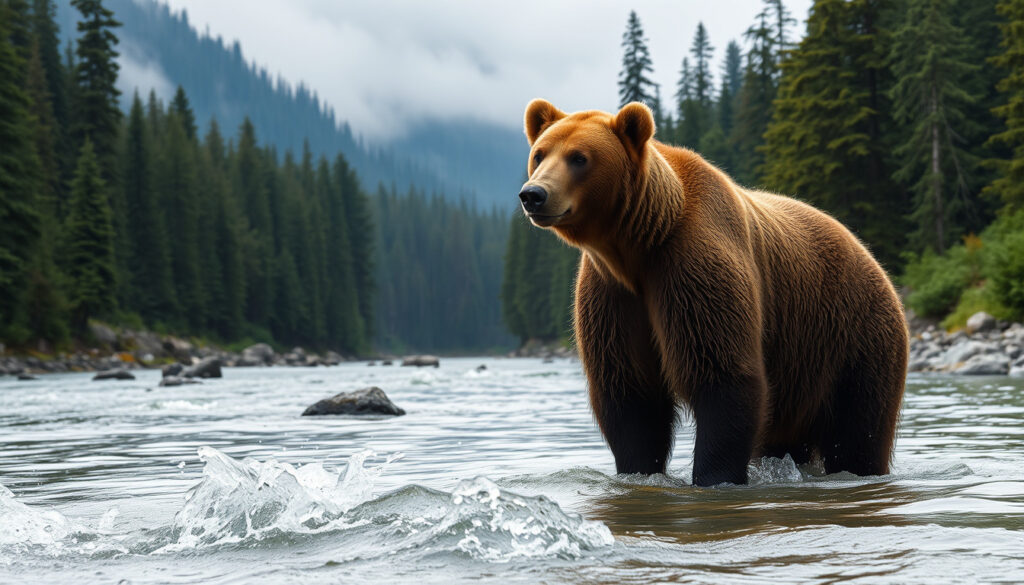
Six key facts, one picture: the grizzly is a highly adaptable omnivore built for the varied landscapes of North America.
| Attribute | Detail |
|---|---|
| Scientific name | Ursus arctos horribilis |
| Family | Ursidae |
| Diet | Omnivore |
| Habitat | Forests, mountains, and coastal areas of North America |
| Lifespan | 20–25 years in the wild |
| Conservation status | Least Concern (overall), but threatened in parts of the U.S. |
Why are bears called grizzly?
What is the origin of the name grizzly?
- The name “grizzly” comes from the term “grizzled,” meaning streaked with gray hair, which describes the silver-tipped guard hairs on their back and shoulders (Wikipedia).
- The scientific name Ursus arctos horribilis was given by naturalist George Ord in 1815, reinforcing the “grisly” (horrible) misconception (Wikipedia).
Does grizzly refer to the bear’s fur color?
Yes, the “grizzled” effect comes from lighter-colored tips on the guard hairs, giving the fur a silver-tipped appearance. This is especially visible on the back and shoulders, creating the distinct “grizzly” look.
The implication: a name born from a visible coat pattern, not a personality trait, though the horribilis tag stuck.
What are 10 facts about grizzly bears?
What is the average size of a grizzly bear?
- Adult males weigh 400–790 lbs; females weigh 250–350 lbs (National Wildlife Federation).
- They stand 3.5–4.5 feet at the hump on all fours and can reach more than 8 feet tall on their hind legs (Montana Fish, Wildlife & Parks).
What do grizzly bears eat?
- Grizzlies are omnivores: berries, salmon, roots, small mammals, and insects make up the bulk of their diet (National Wildlife Federation).
- Despite being apex predators, vegetation often constitutes the majority of their caloric intake.
How fast can a grizzly bear run?
- Grizzlies can sprint up to 35 mph in short bursts and can cover 100 yards in about 7 seconds (Grizzly & Wolf Discovery Center).
- The U.S. National Park Service notes that bears can run as fast as a racehorse both uphill and down.
What is the grizzly bear’s habitat?
- Grizzlies inhabit forests, mountains, and coastal areas of North America, primarily in western Canada, Alaska, and the northwestern United States (WWF Canada).
- They require large, undisturbed spaces for foraging and hibernation.
How long do grizzly bears live?
- Grizzlies have an average lifespan of 20–25 years in the wild (Nature Canada).
- In captivity, they can live beyond 30 years.
The pattern: grizzlies are built for power and endurance, not just aggression.
Is a grizzly stronger than a gorilla?
How does a grizzly bear compare to a gorilla in strength?
Three massive animals, one comparison: size and speed dictate the hierarchy.
| Feature | Grizzly Bear | Silverback Gorilla | Hippopotamus |
|---|---|---|---|
| Average weight | 400–790 lbs (NWF) | 300–500 lbs | 3,000–4,000 lbs |
| Top speed | 35 mph (NWF) | 25 mph | 30 mph |
| Natural disposition | Apex predator, defensive | Omnivore, territorial | Extreme aggression, territorial |
| Primary defense | Size, claws, bite | Strength, agility | Massive size, bite |
The trade-off: raw power vs. agility. In a hypothetical matchup, the grizzly’s size and speed give it a clear advantage, but the gorilla’s intelligence changes the context entirely.
What is a gorilla’s worst enemy?
- Leopards and humans are the gorilla’s main predators.
- Habitat loss and poaching pose the greatest existential threats to gorilla populations.
What is a grizzly bear’s worst enemy?
What animals prey on grizzly bears?
- Adult grizzlies have very few natural predators. They sit at the top of the food chain.
- Cubs may be vulnerable to wolves, mountain lions, or other bears.
Do humans pose a threat to grizzlies?
- Humans are the grizzly bear’s greatest threat through habitat loss, hunting, and climate change (WWF Canada).
- Vehicle collisions and railway kills also contribute to mortality in certain populations.
What is the grizzly bear’s biggest natural predator?
Besides humans, adult grizzlies have no consistent natural predator. Other bears and wolves may compete for food, but they rarely prey on healthy adult grizzlies.
Why this matters: the greatest threat to the apex predator is us.
What smell does a bear hate?
What scents repel grizzly bears?
- Strong smells like ammonia, bleach, and pine-based cleaners can act as temporary deterrents.
- However, the Interagency Grizzly Bear Committee confirms that bear spray is the most effective tool for deterring aggressive bears.
Despite being an apex predator, vegetation makes up the majority of a grizzly bear’s diet. This highlights their role as ecological engineers, spreading seeds and nutrients across vast landscapes.
How can you use smell to deter a grizzly bear?
- Store food in bear-proof containers to prevent attracting bears with food odors.
- Hike in groups of three or more and make noise to avoid surprising a bear (BearWise).
- Do not rely on scent alone; bear spray is the recommended deterrent.
The catch: relying on smell alone is dangerous; behavior is the real deterrent.
What is the 3 bear rule?
What are the three bear rules for camping?
- Don’t surprise bears: Make noise, especially near streams or dense brush.
- Don’t approach bears: Give them plenty of space — at least 100 yards.
- Don’t run from bears: Running triggers their chase instinct.
What is the best way to avoid a grizzly bear attack?
- Stay calm and identify yourself as a human.
- Stand your ground and do not run.
- Wave your arms slowly to appear larger.
- Use bear spray if the bear approaches aggressively.
- If attacked by a grizzly, play dead by lying flat on your stomach with your hands clasped behind your neck (U.S. National Park Service).
Running from a grizzly triggers their chase instinct. Standing your ground is counterintuitive but critical.
The bottom line: preparation replaces panic.
Perspectives from the field
It was pure panic. I didn’t know if I was going to live or die.
— Daniel Crago, hiker attacked in Glacier National Park (Backpacker)
Making noise is the best way to avoid surprising a bear. Most attacks happen when a bear is startled at close range.
Grizzly bears are not the man-eating monsters of folklore. They are a powerful, defensive apex predator that wants to avoid conflict.
— National Wildlife Federation
Related reading: Yogi Bear: Catchphrase, Sidekick, and Girlfriend Facts · Black Panther: Marvel Movie vs Real Animal – Facts, Cast & Future
grizzlytimes.org, instagram.com, sabrered.com, hotellitvertailu.fi
For a thorough overview of grizzly bear size and behavior, a detailed grizzly bear fact guide provides an excellent resource.
Frequently asked questions
What part of a human does a bear eat first?
Bears typically target the torso and limbs first, as they are the largest parts of the body.
What animal hunts humans the most?
Mosquitoes, through disease transmission. For large predators, tigers and crocodiles are responsible for the most attacks.
How much does a grizzly bear weigh?
Adult males weigh 400–790 lbs, while females weigh 250–350 lbs (National Wildlife Federation).
How tall is a grizzly bear when standing up?
Grizzlies can reach 6–8 feet tall when standing on their hind legs (Montana Fish, Wildlife & Parks).
What is the geographic range of the grizzly bear?
Grizzlies are found in the western United States (primarily Yellowstone and Glacier ecosystems), Canada (British Columbia, Alberta, Yukon), and Alaska (WWF Canada).
More related posts
 Omar Sy: Biography, Ethnicity, Net Worth, and Lupin
 National Living Wage 2025: UK & Ireland Rates Explained
 5 Foot 5 in CM: 165.1 cm Exact Conversion + Chart
 Sian Gibson: Career, Family, and Latest Updates
 Shay Mitchell: Biography, Age, Net Worth, Partner, and Children
 Teri Hatcher: Childhood Tragedy, Feuds, and Life at 59
 Paul Ritter: Brain Tumour, Cause of Death & Famous Roles
 Frank Bruno Now: Career, Net Worth, Health, and Life in 2024