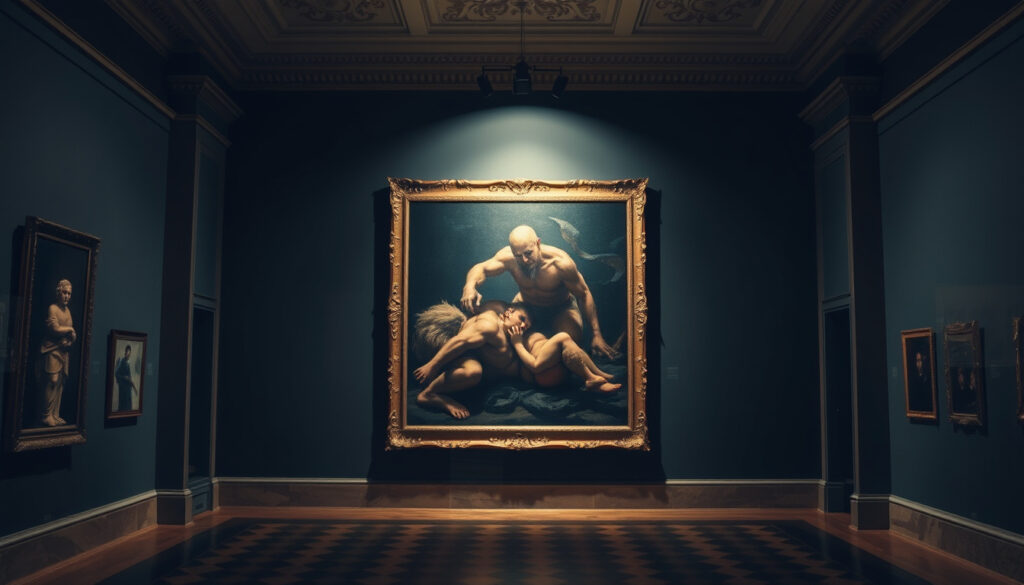
Saturn Devouring His Son: Meaning, Symbolism & Location
Few paintings capture a descent into darkness as powerfully as Francisco Goya’s Saturn Devouring His Son. Created between 1821 and 1823 on the walls of his country house, this haunting image of a god consuming his own child continues to provoke questions about mythology, politics, and the artist’s own sanity. Here’s what the experts say about its meaning and where you can see it today.
Title: Saturn Devouring His Son ·
Artist: Francisco Goya (Spanish, 1746–1828) ·
Year: 1821–1823 ·
Medium: Mixed technique on wall, later transferred to canvas ·
Dimensions: 143.5 × 81.4 cm ·
Location: Museo del Prado, Madrid, Spain
Quick snapshot
- Goya painted the work circa 1821–1823 (Museo del Prado – official collection entry)
- It is one of the 14 Black Paintings (Britannica – art history reference)
- The painting depicts the Roman god Saturn consuming a child (Britannica – art history reference)
- Whether the child is male or female – debated by art historians
- The exact meaning: political, autobiographical, or universal allegory
- Goya’s specific mental condition at the time of painting
- 1821–1823: Painted on wall of Quinta del Sordo (Museo del Prado)
- 1874: Transferred from wall to canvas by Salvador Martínez Cubells (Museo del Prado)
- 1881: Donated to Museo del Prado (Britannica – provenance)
- The painting remains on permanent display at the Prado
- Exhibitions continue to reinterpret its meaning in modern contexts
Seven key identifiers, one pattern: every number tells part of a story that begins on a villa wall and ends in a world‑renowned museum.
| Attribute | Value |
|---|---|
| Full Title | Saturn Devouring His Son (also Saturn Devouring One of His Children) |
| Artist | Francisco Goya y Lucientes (1746–1828) |
| Date | 1821–1823 |
| Medium | Oil on plaster, transferred to canvas |
| Dimensions | 143.5 cm × 81.4 cm (56.5 in × 32.0 in) |
| Location | Museo del Prado, Madrid, Spain |
| Part of Series | Black Paintings (Pinturas Negras) |
Why did Saturn devour his children?
The Roman myth of Saturn and his prophecy
In Roman mythology, Saturn (equivalent to the Greek Cronus) was warned by an oracle that one of his own children would overthrow him, just as he had overthrown his father Caelus. To prevent this, Saturn swallowed each newborn whole. The Museo del Prado describes the subject as Saturn devouring one of his sons and notes that the god may personify the human fear of losing power (Museo del Prado – collection entry). Britannica confirms that the painting is commonly read as Goya’s interpretation of the myth in which Gaea predicted that one of Cronus’s children would overthrow him (Britannica Video – art history analysis).
Saturn’s fear of being overthrown
The myth parallels Goya’s personal fears and the political context of post‑Napoleonic Spain. The god’s wide‑eyed expression suggests madness and paranoia (Britannica – art history reference). Goya’s version differs from the classical myth because it depicts violent tearing rather than swallowing whole (Britannica Video).
Goya’s Saturn is simultaneously the aggressor and the victim. His paranoid stare suggests that the act of devouring his child does not free him; it condemns him to an endless cycle of fear and violence. The implication: power consumed by fear is already self‑defeating.
What this means: Goya takes a myth about preserving power and turns it into a study of self‑destruction. The god’s bulging eyes and bloody hands tell us that the prophecy is already coming true — not through the child, but through the father’s own unhinged actions.
What does Goya’s Saturn symbolize?
Political allegory of Spain’s turmoil
Many art historians read the painting as a political allegory for the violence that plagued Spain — the Peninsular War, the destruction of a generation, and the repressive regime that followed. According to Artnet News, the work can be interpreted as a critique of war and the nation’s self‑consuming conflicts (Artnet News – cultural reporting).
Goya’s personal demons
Others view it as a representation of Goya’s deteriorating mental state. Isolated, deaf, and in declining health, the artist may have painted Saturn as a self‑portrait of his own internal chaos. The desperate grip and the half‑consumed body mirror what the artist saw in himself: a man devouring his own vitality. The Prado notes that the work is one of the Black Paintings, executed during a period of isolation and despair (Museo del Prado – Black Paintings context).
Symbol of time and mortality
Art critic Robert Hughes called it “an image of the sheer, blind, self‑consuming fury of time.” The act of consuming one’s own child reflects the cyclical nature of history, where each generation devours the next. Britannica mentions that the painting may also be about God’s wrath, the conflict between old age and youth, or Saturn as Time devouring all things (Britannica – interpretive range).
A single painting supports three radically different readings — political, psychological, and philosophical — without diminishing any of them. For contemporary viewers, that layered ambiguity is precisely why the image retains its power: it refuses to be pinned down.
The trade‑off: The painting’s interpretive freedom is also its challenge. Without settling on one meaning, it leaves the viewer to supply the context. That openness is what separates Goya’s Saturn from a simple mythological illustration.
Where is Saturn Devouring His Son now?
Museo del Prado, Madrid
The painting is housed at the Museo Nacional del Prado in Madrid, Spain (Museo del Prado – location). It forms part of the museum’s permanent collection and is displayed alongside the other Black Paintings. The Prado’s description identifies the work as oil mural transferred to canvas (Museo del Prado – medium attribution).
How the painting was moved from Goya’s home to canvas
Originally painted directly onto the wall of Goya’s villa, the Quinta del Sordo, the work was transferred to canvas in 1874 by the Spanish painter Salvador Martínez Cubells. The Prado states that the painting occupied the wall across from Leocadia Zorrilla on the ground floor of the villa (Britannica – original placement). The transfer process was fragile, and some paint loss occurred, but the composition remains largely intact.
The catch: The very act of preservation — moving wet plaster to canvas — forever changed the work’s surface texture. Today’s viewer sees both Goya’s original stroke and a two‑century history of restoration in every inch.
What happened after Saturn ate his son?
Jupiter’s survival and eventual overthrow of Saturn
In the myth, Saturn’s wife Rhea hid the infant Jupiter (Zeus) in a cave on Crete, feeding Saturn a stone wrapped in swaddling instead. Jupiter survived, grew to adulthood, and forced Saturn to regurgitate his siblings. The prophecy was fulfilled: Jupiter overthrew Saturn and became king of the gods (Britannica – myth continuation). Goya, however, does not show this resolution. The painting freezes the moment before any possible reversal — the child is already half‑eaten, the god still gripping the corpse.
The prophecy fulfilled
By omitting Jupiter’s survival, Goya denies the viewer any hope of cosmic justice. The act is irreversible. Spectators are left with the raw consequences of fear-driven violence, without the redeeming sequel found in the classical story.
The implication: Goya deliberately truncates the myth to make a darker point. In his version, there is no rescue, no restoration of order — only the endless, smothering present of consumption. It is history without redemption.
What was Goya’s mental illness?
Goya’s deafness after an illness
Goya suffered a severe illness in 1792 that left him permanently deaf. Though he regained some mobility, the deafness isolated him from society and deepened the misanthropic turn visible in his later work. Britannica’s wide‑eyed Saturn commentary is often linked to the artist’s documented psychic distress (Britannica – Goya’s mental state).
Possible causes: lead poisoning, stroke, syphilis
No definitive diagnosis exists, but modern researchers propose lead poisoning from paint pigments as a likely culprit. Others suggest a stroke, syphilis, or progressive dementia. The Black Paintings were executed precisely during this period of isolation and despair, and many see Saturn as a direct visual manifestation of the artist’s inner turmoil. Artnet News notes that some interpretations connect the painting to Goya’s old age and fear of mortality (Artnet News – biographical reading).
Effect on his late works
The disease or poisoning loosened Goya’s inhibitions, leading to increasingly raw and hallucinatory imagery. The Black Paintings, including Saturn, were executed without commission and never intended for public display. A specialist art‑history source suggests that Goya’s treatment of the subject may not be mythologically literal, but instead depicts a more psychologically charged, gender‑ambiguous victim (19thCenturyArt‑FACOS – scholarly interpretation).
If Goya’s condition was lead poisoning (common among artists of his era), then the very pigments he used to create the Black Paintings may have accelerated the madness they depict. The medium becomes part of the message — a grim symbiosis of art and illness.
The trade‑off: Without a post‑mortem diagnosis, all explanations remain speculative. That uncertainty forces viewers to engage with the painting on its own unnerving terms, rather than explaining it away with a medical label.
What we know and what remains open
Confirmed facts
- Goya painted the work around 1821–1823 on the wall of Quinta del Sordo (Museo del Prado)
- It is one of the 14 Black Paintings (Britannica)
- The subject is the Roman god Saturn devouring a child (Britannica)
- The painting was transferred to canvas in 1874 and donated to the Prado in 1881 (Britannica – provenance)
What’s unclear
- Whether the consumed child is male or female – debated (19thCenturyArt‑FACOS)
- Exact meaning — political, autobiographical, or universal allegory
- Goya’s specific mental condition at the time
- Whether Goya saw a Rubens version of the same subject in Madrid (possible, unconfirmed) (19thCenturyArt‑FACOS)
Voices on Saturn
“Goya’s Saturn is an image of the sheer, blind, self‑consuming fury of time.”
— Robert Hughes, art critic and historian
“A terrifying vision of the god devouring his son, a metaphor for the destructive nature of time.”
— Museo del Prado, official collection description
bridgemanimages.com, simplykalaa.com, commons.wikimedia.org, museodelprado.es, facebook.com, britannica.com, reddit.com, reddit.com, singaporereport.net
Frequently asked questions
Is Saturn Devouring His Son a true story?
It is based on the Roman myth of Saturn (Cronus), who devoured his children to prevent a prophecy. Goya painted his own dramatic interpretation of the myth (Britannica).
Why is Saturn Devouring His Son so famous?
Its raw, violent imagery and layered symbolism — political, autobiographical, and philosophical — make it one of the most discussed paintings in Western art. It belongs to Goya’s mysterious Black Paintings series (Museo del Prado).
What does the blood in the painting represent?
Interpretations vary: blood can symbolize violence, the cycle of life and death, or the destructive nature of time. Britannica notes that the painting may address God’s wrath and the conflict between old age and youth (Britannica).
How large is the original painting?
It measures 143.5 cm × 81.4 cm (56.5 in × 32.0 in) (Museo del Prado).
Can I see Saturn Devouring His Son at the Prado?
Yes, it is on permanent display at the Museo Nacional del Prado in Madrid, Spain (Museo del Prado).
Did Goya paint any other versions of Saturn?
No known surviving versions by Goya exist. However, Peter Paul Rubens painted a famous treatment of the same subject in the 1630s, which Goya may have seen in Madrid (19thCenturyArt‑FACOS).
What other paintings are in the Black Paintings series?
The series includes 14 works such as Witches’ Sabbath, Judith and Holofernes, and The Dog. All were painted on the walls of Goya’s villa and later transferred to canvas (Britannica – Black Paintings list).
Goya’s Saturn Devouring His Son remains a mirror held up to every age that consumes its own young — whether through war, neglect, or fear of the future. For visitors to the Prado, the choice is simple: confront the raw horror of time itself, or look away.
More related posts
 Channel 5.com/activate Guide: How to Activate My5 on TV
 Skai Jackson: Biography, Baby, Arrest, Life After Disney
 Balvinder Sopal: Age, Children, Family Tragedy & Strictly Come Dancing
 1 GBP to PKR: British Pounds to Pakistani Rupees Rate
 Aston Villa vs RB Salzburg Lineups – Predicted XI, Team News, Injuries
 How Long Does Menopause Last? Duration, Stages, and Symptoms
 Sian Gibson: Career, Family, and Latest Updates