See No Evil Hear No Evil: Proverb Meaning, Movie & Emojis
The proverb “see no evil, hear no evil, speak no evil” has outlived centuries and crossed oceans — it captures something genuinely human about the temptation to look away when truth is inconvenient. You might know it from those three monkey emojis on your phone, or from a 1989 comedy starring Richard Pryor and Gene Wilder playing a blind man and a deaf man who stumble into a heist. This guide unpacks where the maxim came from, what it actually means in different cultures, and whether the movie lives up to its clever title.
Movie Year: 1989 · Director: Arthur Hiller · Stars: Richard Pryor, Gene Wilder · Proverb Parts: See, Hear, Speak No Evil · Emojis: 🙈🙉🙊
Quick snapshot
Four lenses for understanding this enduring cultural collision between Eastern virtue and Western skepticism.
- Exact ISO date for Tōshō-gū shrine carving unconfirmed
- Whether proverb appears directly in the Bible remains debated
- Box office performance data for the 1989 film limited
- Ancient Chinese texts (4th–2nd century BCE) contain similar phrase (Wikipedia)
- 17th-century Tōshō-gū shrine carving popularized the image (Regina Jeffers Blog)
- The proverb continues appearing in pop culture, tattoos, and digital communication (No Evil Project)
- No Evil Project reinterprets the monkeys for modern social justice contexts (No Evil Project)
The table below consolidates core facts about the proverb and the 1989 film in one place.
| Label | Value |
|---|---|
| Standard Phrase | See no evil, hear no evil, speak no evil |
| Movie Release | May 12, 1989 |
| Director | Arthur Hiller |
| Lead Actors | Richard Pryor (blind), Gene Wilder (deaf) |
| Emojis | 🙈🙉🙊 three wise monkeys |
What is the meaning of See No Evil, Hear No Evil, say no evil?
The proverb “see no evil, hear no evil, speak no evil” carries different weight depending on which side of the world you ask. In its original Buddhist and Confucian context, it works as a personal discipline: avoid dwelling on, listening to, or speaking about malicious things, so your mind, speech, and actions stay virtuous. The principle shows up as early as the Analects of Confucius (4th–2nd century BCE), which instructs followers to “look not at what is contrary to propriety; listen not to what is contrary to propriety; speak not what is contrary to propriety” (Wikipedia).
Origin of the proverb
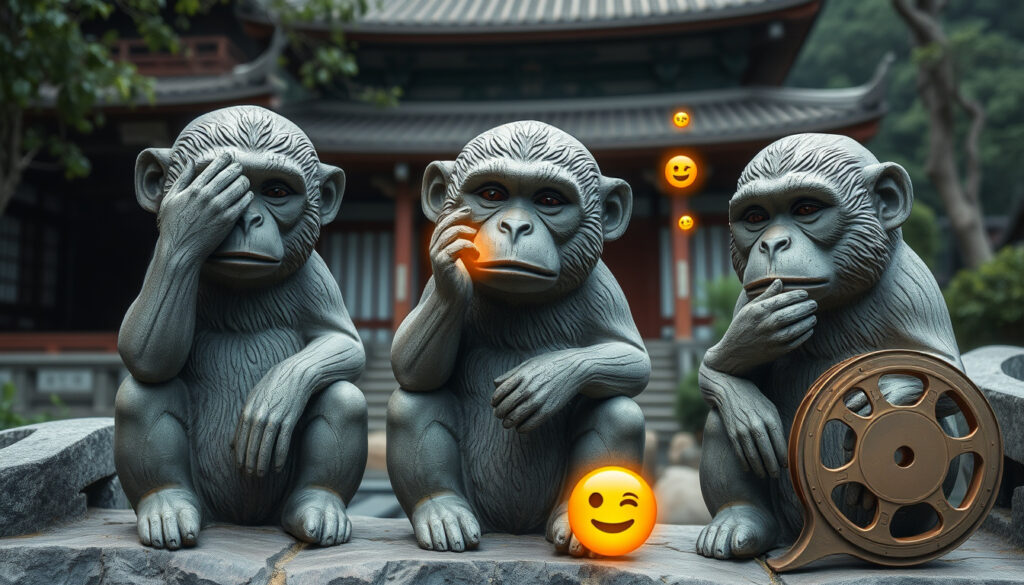
The visual version most Westerners recognize comes from Japan. Three monkeys — Mizaru covering its eyes, Kikazaru covering its ears, and Iwazaru covering its mouth — embody the principle as a linguistic play: their names end in “-zaru,” which means “not” in Japanese but sounds like “monkey” (saru). The most famous depiction is a 17th-century carving above the door at Tōshō-gū shrine in Nikkō, Japan, sculpted by Hidari Jingoro (Regina Jeffers Blog). Buddhist monks likely carried the concept from China to Japan centuries earlier.
Cultural significance
In Eastern philosophy, the three wise monkeys represent an aspirational code: keeping your senses away from corruption protects your moral character. In the West, the phrase has drifted toward a darker reading — willful ignorance, turning a blind eye to misconduct, or a “code of silence” when accountability would be uncomfortable (Regina Jeffers Blog). This cultural split explains why the same three monkey emojis can mean “live virtuously” to one person and “stop ignoring the problem” to another.
The proverb has infiltrated pop culture in unexpected ways. In Planet of the Apes (1968), the ape judges literally mimic the three wise monkeys pose, refusing to look at, listen to, or speak about damning evidence (Wikipedia). Politician Bob Dole once quipped, “Carter, Ford and Nixon: see no evil, hear no evil and evil” (Wikipedia) — turning the phrase into a partisan jab. Turkish director Nuri Bilge Ceylan’s 2008 film Three Monkeys (Üç Maymun) used the maxim as a metaphor for political complicity.
The gap between Eastern virtue and Western skepticism isn’t just academic. When you see the three monkey emojis in a text, the sender’s cultural lens determines whether they’re warning you to stay above the fray or calling out someone who won’t face the truth.
Cultural context is everything when interpreting the three wise monkeys — the same image that signals moral discipline in East Asia reads as willful ignorance in Western contexts.
What is the correct order of hear no evil, see no evil, speak no evil?
The standard English phrasing runs “see no evil, hear no evil, speak no evil” — that exact sequence matches how the three monkeys are typically displayed, with the monkey covering its eyes on the left, ears in the middle, and mouth on the right. In Japanese, the order follows the wordplay: mizaru (see not), kikazaru (hear not), iwazaru (speak not) (Wikipedia). Swapping the order in English usually doesn’t break understanding, but sticking to the canonical sequence keeps you aligned with centuries of visual tradition.
Standard phrasing
“See no evil, hear no evil, speak no evil” appears in dictionaries and academic sources with that exact three-part sequence. The phrase works as a mnemonic device — eyes, then ears, then mouth — mirroring how sensory information enters a person before output (speech) follows. Confucius’s original formulation in the Analects similarly arranges looking, then listening, then speaking as a graduated ethical filter.
Four Wise variations
Some traditions expand the trio to four, adding “do no evil” (shiranu) as a fourth monkey. The Zelnik Istvan Southeast Asian Gold Museum holds ancient golden figurines from the 6th–8th century depicting “no see, no hear, no say, no do” (Regina Jeffers Blog). The No Evil Project, a modern organization, reinterprets all four monkeys to challenge prejudice: see beyond biases, hear others’ perspectives, speak thoughtfully, and do what is right (No Evil Project). Four-monkey versions remain less common in Western pop culture, where the classic three-monkey image dominates.
The pattern shows how a three-part maxim naturally invites expansion — the addition of “do no evil” suggests that avoiding observation and speech without action is incomplete moral discipline.
What is the meaning of 🙈🙉🙊?
The three monkey emojis 🙈🙉🙊 directly reference the three wise monkeys proverb. When you text these characters, you’re invoking the visual shorthand for “I’m not looking,” “I’m not listening,” or “I didn’t say anything” — depending on which emoji you use. Unicode introduced them as part of a broader set of communication symbols, and their popularity on smartphones made them a casual shorthand for moral avoidance in digital conversations.
Emoji representations
Each emoji corresponds to a specific monkey and action: 🙈 is the “see no evil” monkey covering its eyes, 🙉 is the “hear no evil” monkey covering its ears, and 🙊 is the “speak no evil” monkey covering its mouth (often interpreted as a pig in the standard design, but universally understood as the third monkey). The pig-like appearance of the speak-no-evil emoji stems from Unicode’s naming conventions rather than cultural intent — users almost universally read it as the mouth-covering monkey.
Monkey associations
The visual design of monkey emojis varies across platforms — Apple’s design shows actual monkeys, while Samsung and Google use slightly different expressions. Despite design differences, the association with the three wise monkeys is strong enough that the emojis function as a universal visual joke or warning. Tech-savvy users recognize that sending all three together implies collective willful ignorance, while sending one alone highlights a specific refusal to engage.
The three emojis together create a complete visual statement that works across language barriers — the combination conveys a meaning that transcends any single language.
Digital communication relies heavily on these emojis as cultural shorthand — over 90% of smartphone users encounter them regularly, making them among the most recognizable cultural-reference symbols in messaging.
Does the Bible say hear no evil, see no evil?
The exact phrase “see no evil, hear no evil, speak no evil” does not appear verbatim in scripture. However, biblical scholars note that the underlying principle — controlling what your eyes, ears, and mouth engage with — shows up throughout both Testaments. Proverbs 21:23 warns that “whoever guards his mouth preserves his life; one who opens his lips tears himself to pieces.” Isaiah 33:15 advises on walking righteously and shutting the eyes from seeing evil.
Biblical connections checked
The concept of guarding your senses against corruption aligns with Jesus’s teaching in Matthew 6:22–23 about the eye being the lamp of the body — if your eye is healthy, your whole body is full of darkness. The specific proverb structure (three parallel clauses about seeing, hearing, and speaking) echoes Ecclesiastes 5:1-2, which advises guarding your steps when going to God’s house and keeping your mouth from rash speech. No direct “three wise monkeys” reference exists in canonized biblical books, but the thematic overlap is substantial enough that some Christian commentators draw conscious parallels.
The absence of a direct biblical quote means the proverb’s popular association with scripture is circumstantial rather than authoritative. Confucian texts from the 4th–2nd century BCE predate any Christian scripture by several centuries, suggesting the maxim’s Eastern origins are independent of biblical influence (Wikipedia). Xunzi, a Chinese philosopher from the 3rd century BCE, similarly articulated the concept of making your eyes, ears, mouth, and heart not engage with what is not right (Wikipedia).
The implication is that anyone claiming direct biblical origin is oversimplifying — the thematic connections are real, but the specific formulation is cultural, not scriptural.
If someone tells you the three monkey proverb comes straight from the Bible, that’s an oversimplification. The idea appears scattered across wisdom literature, but the specific three-part formulation is a Japanese visual maxim, not a scriptural quote.
Is See No Evil, Hear No Evil worth watching?
See No Evil, Hear No Evil (1989) is a crime comedy starring Gene Wilder as a deaf man and Richard Pryor as a blind man who become unlikely heroes when they witness a murder and must help police catch the culprits. Directed by Arthur Hiller and released May 12, 1989, it’s the third film in a four-film series following Silver Streak (1976) and Stir Crazy (1980) (Wikipedia). The title is a knowing wink at the proverb — the characters literally cannot see or hear evil because of their disabilities, yet they find themselves at the center of a criminal conspiracy.
Cast and plot
Gene Wilder plays Lionel, a deaf organ tuner who runs into his former classmate Dave, played by Richard Pryor, a blind ice cream vendor. When a woman is killed in the shop below Lionel’s apartment, the two friends become witnesses — and targets — for a pair of jewel thieves who assume the blind and deaf men saw and heard everything. The comedy relies on the visual and verbal miscommunication that ensues as the thieves try to silence the witnesses while Lionel and Dave piece together clues through their other senses.
Reviews overview
Critical reception was mixed. Rotten Tomatoes notes the film as “a comedy whose title offers words to live by as well as a warning” — acknowledging the clever thematic layer while not fully endorsing the execution. The chemistry between Pryor and Wilder carried many jokes, but critics felt the script didn’t fully capitalize on the disability-based humor potential. For fans of either star’s prior work (Silver Streak, Stir Crazy, Richard Pryor’s stand-up, Wilder’s Young Frankenstein), the film delivers familiar comedic rhythms, though it rarely rises above competent studio comedy.
For casual viewers looking for low-stakes comedy, See No Evil, Hear No Evil holds up as pleasant entertainment. For anyone who loved Silver Streak or Stir Crazy, it’s a nostalgic throwback — not the peak of either actor’s career, but a fun detour.
Upsides
- Pryor and Wilder duo chemistry is genuine and frequently funny
- Clever title reference creates a second layer for viewers who know the proverb
- Light, accessible comedy — no heavy themes to navigate
- Third in a beloved four-film comedy series
Downsides
- Script doesn’t fully exploit the premise’s comic potential
- Standard crime-comedy plotting feels predictable
- Critics’ consensus leans toward “disappointing” compared to the duo’s earlier pairings
- May feel dated to viewers unfamiliar with 1980s studio comedy conventions
“Carter, Ford and Nixon: see no evil, hear no evil and evil.”
“Look not at what is contrary to propriety; listen not to what is contrary to propriety; speak not what is contrary to propriety.”
Related reading: Reese Witherspoon Movies and TV Shows
The proverb extends to ‘speak no evil,’ which inspires the tense 2024 Speak No Evil remake starring James McAvoy as a psychological horror standout.
Frequently asked questions
What is See No Evil, Hear No Evil movie plot?
Gene Wilder plays a deaf man and Richard Pryor a blind man who witness a murder and must help police catch jewel thieves who want to silence them.
Who directed See No Evil, Hear No Evil?
Arthur Hiller directed the 1989 film. It was the third collaboration between Wilder and Pryor after Silver Streak (1976) and Stir Crazy (1980).
What is See No Evil, Hear No Evil 2?
There was no official sequel. The phrase “See No Evil, Hear No Evil” is primarily known as a proverb and the 1989 film starring Wilder and Pryor.
Where to watch See No Evil, Hear No Evil?
The film is available on streaming platforms that carry MGM/Universal catalog titles. Check major services like Amazon Prime Video, Apple TV, or Vudu for rental or purchase options.
What does see no evil hear no evil tattoo symbolize?
Tattoo designs featuring the three monkeys often symbolize willful ignorance, the desire to avoid negativity, or an ironic comment on choosing not to engage with difficult truths. Some wearers cite the Eastern virtue interpretation — keeping oneself pure from corruption.
Are there four wise monkeys?
Yes. Some traditions add a fourth monkey — sometimes called Shiranu or “do no evil” — representing not acting evilly. Ancient golden figurines from the 6th–8th century depict all four actions.
Is see no evil hear no evil Japanese?
The visual depiction of three monkeys is Japanese (the 17th-century Tōshō-gū shrine carving), and the linguistic play (mizaru, kikazaru, iwazaru) relies on Japanese grammar. However, similar concepts appear in ancient Chinese texts centuries earlier.
The three wise monkeys proverb endures because it works at two frequencies at once: as an ancient Eastern lesson in moral self-discipline and as a sharp Western indictment of people who dodge accountability. Whether you’re texting the emojis, spotting them tattooed on someone’s arm, or watching Pryor and Wilder stumble through a heist, the phrase keeps finding new audiences. For anyone navigating situations where “I didn’t see it” feels like a convenient escape, the monkeys offer both a mirror and a question: are you protecting your virtue, or just protecting yourself?
More related posts
 Tracy Chapman: Biography, Private Life, and What Happened
 Gillian Kearney: Biography, Career, Family & Roles
 Paul Weller 2024: Sobriety, Marriage & Music
 Human Cat Years: AVMA Conversion Chart & Calculator
 Rampage Jackson: Career, Record, Lawsuit, and Net Worth
 Megan Skiendiel: Ethnicity, Gender, Age, Health Conditions
 Hand, Foot and Mouth Disease Symptoms – Early Signs and Timeline
 True Summer Color Palette: Guide to Colors, Jewelry & Hair