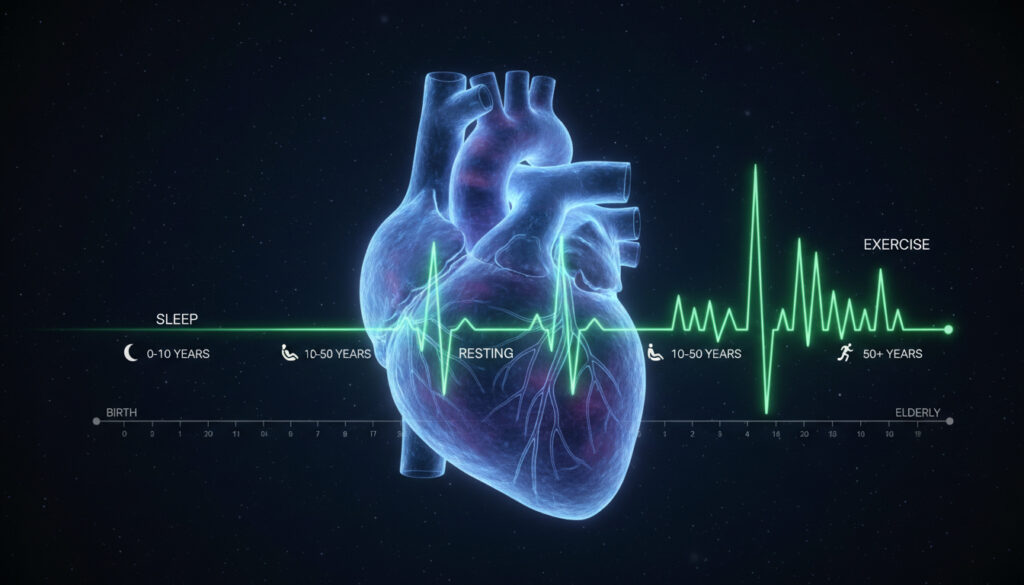
What Is a Normal Heart Rate – By Age, Resting, Sleep & Exercise
A normal resting heart rate for most adults falls between 60 and 100 beats per minute, though this range shifts significantly depending on age, physical conditioning, and current activity levels.
Understanding where your heart rate sits within established parameters provides crucial insight into cardiovascular efficiency and overall physiological fitness. While medical authorities define clear benchmarks, individual variation remains substantial, requiring careful interpretation of personal data.
This examination breaks down physiological norms across life stages, identifies when fluctuations signal genuine concern, and explains precise methods for obtaining accurate measurements outside clinical settings.
What Is a Normal Resting Heart Rate for Adults?
- Standard clinical range remains 60-100 bpm for adults at complete rest
- Lower resting rates typically correlate with superior cardiovascular fitness
- Well-trained athletes commonly exhibit rates between 40 and 60 bpm
- Women average 2-7 bpm higher than men due to physiological differences
- Single measurements provide limited diagnostic value compared to longitudinal trends
- Early morning readings offer the most consistent baseline data
- Persistent readings outside standard ranges merit professional consultation
The American Heart Association establishes 60-100 bpm as the standard resting range for adults. However, Cleveland Clinic cardiologists note that well-conditioned athletes frequently demonstrate rates as low as 40 bpm without pathology, reflecting enhanced cardiac stroke volume.
| Age Group | Resting BPM | Clinical Context |
|---|---|---|
| Preterm Infants | 120-180 | Higher metabolic demands |
| Newborn (0-1 month) | 100-160 | Postnatal stabilization period |
| Infant (1-12 months) | 80-140 | Rapid developmental growth phase |
| Toddler (1-3 years) | 80-130 | Elevated versus adult norms |
| Child (6-15 years) | 70-100 | Transitioning toward adult range |
| Adult (18+ years) | 60-100 | Standard resting parameter |
| Athlete | 40-60 | Indicates cardiac efficiency |
| Elderly (65+ years) | 62-65 (ideal) | May rise slightly after age 80 |
MedicineNet research indicates that adults maintaining rates between 55-85 bpm generally demonstrate superior cardiovascular fitness and reduced risk of cardiac events compared to those near the upper threshold.
What Is a Normal Heart Rate by Age?
Infants and Children
Pediatric cardiac physiology demands substantially higher rates than adult benchmarks. According to NCBI developmental data, preterm infants sustain 120-180 bpm, while full-term newborns (0-1 month) range between 100-160 bpm. This gradually decreases throughout infancy (80-140 bpm) and toddlerhood (80-130 bpm). By age 10, children approach adult ranges of 60-100 bpm, per Asian Heart Institute guidelines.
Children maintain higher heart rates than adults because their hearts are smaller and must beat faster to circulate blood through growing bodies and meet elevated metabolic demands.
Adults by Decade
Resting heart rates demonstrate subtle declines through middle adulthood before slight increases in advanced age. Data from Healthline shows adults aged 18-20 average 81.6 bpm, decreasing to 73.9 bpm by ages 51-60. Notably, rates slightly rise again after age 80 (78.1 bpm), potentially reflecting age-related changes in cardiac conduction systems and reduced physical activity levels.
Elderly Considerations
Adults over 65 typically achieve optimal cardiovascular health with resting rates between 62-65 bpm. While the standard 60-100 bpm range technically applies, older adults experiencing sustained rates above 80 bpm may face elevated cardiovascular risk, particularly when combined with other comorbidities.
What Is a Normal Heart Rate During Sleep or Exercise?
During Sleep
Cardiac rhythm slows during sleep as metabolic demands decrease. Cleveland Clinic specialists note that poor sleep quality elevates resting heart rate, while well-rested individuals typically demonstrate rates 10-20 bpm lower than waking measurements. Chronic sleep deprivation can establish persistently elevated baselines, masking true cardiovascular fitness levels.
Exercise Target Zones
During physical exertion, heart rate increases proportionally to oxygen demands. According to Everlywell and American Heart Association guidelines, maximum heart rate approximates 220 minus age. Target exercise zones vary by intensity: moderate activity maintains 50-70% of maximum, while vigorous exertion reaches 70-85%.
For a 40-year-old, maximum heart rate approximates 180 bpm. Moderate activity should elevate pulse to 90-126 bpm, while vigorous exercise ranges from 126 to 153 bpm.
When Is a Heart Rate Too High or Dangerous?
Medical professionals distinguish between physiological elevation and pathological tachycardia. Asian Heart Institute cardiologists define tachycardia as exceeding 100 bpm at rest when accompanied by symptoms such as chest pain, shortness of breath, or dizziness. Conversely, bradycardia (below 60 bpm) proves normal for athletes but may indicate conduction abnormalities in symptomatic non-athletes.
Research cited by Everlywell links sustained resting rates above 80 bpm with higher cardiovascular disease risk, though this threshold remains contested without accompanying symptoms. Healthline medical reviewers emphasize that context— including recent caffeine intake, stress, and medication use —determines whether elevated readings require emergency intervention.
Resting rates consistently exceeding 100 bpm or dropping below 60 bpm when accompanied by dizziness, chest discomfort, or breathlessness require immediate medical evaluation to rule out arrhythmia, thyroid dysfunction, or cardiac pathology.
How Does Heart Rate Change Throughout Life?
- Fetal Development: Heart rates estimated at 120-160 bpm
- Newborn Phase (0-1 month): 100-160 bpm as circulatory systems adapt to extrauterine life
- Infancy (1-12 months): 80-140 bpm supporting rapid growth
- Toddler Years (1-3 years): 80-130 bpm gradually decelerating
- School Age (6-15 years): 70-100 bpm approaching adult parameters
- Adulthood (18-64 years): 60-100 bpm stabilized range
- Advanced Age (65+ years): 60-100+ bpm with increased individual variability
What Do We Know for Certain About Normal Heart Rates?
| Established Information | Information Requiring Context |
|---|---|
| The American Heart Association defines normal adult resting heart rate as 60-100 bpm | Precise “optimal” individual rates without complete medical history and genetic profiling |
| Regular cardiovascular training demonstrably lowers resting heart rate through increased stroke volume | Clinical significance of minor deviations (e.g., 58 versus 62 bpm) in asymptomatic individuals |
| Heart rate decreases progressively from birth through adolescence, stabilizing in adulthood | Long-term implications of sustained rates in the 80-100 bpm range for specific demographics |
| Women consistently demonstrate marginally higher rates than men across age groups | Exact thresholds requiring intervention when no symptoms present |
Why Does Context Matter When Reading Your Pulse?
Multiple variables influence cardiac rhythm beyond age and baseline fitness. Pharmaceutical interventions, particularly beta-blockers, reduce heart rate, while decongestants and thyroid medications may elevate it. Pregnancy increases resting pulse significantly to support placental circulation.
Additional factors include psychological stress, ambient temperature, body mass index, anemia, caffeine and alcohol consumption, acute illness, and hydration status. Understanding these modifiers prevents unnecessary alarm when encountering single anomalous readings. For comprehensive cardiovascular health assessment, consider how these metrics relate to broader conditions discussed in What Is Cardiovascular Disease – Causes, Symptoms, Types.
What Do Leading Medical Authorities Say?
For most adults, a normal resting heart rate is between 60 and 100 beats per minute. Generally, a lower heart rate at rest implies more efficient heart function and better cardiovascular fitness.
— American Heart Association
Well-trained athletes may have resting heart rates between 40 and 60 beats per minute. This is because exercise strengthens the heart muscle, allowing it to pump more blood with each beat.
— Cleveland Clinic
Adults 18-65+ with resting heart rates between 62-67 bpm (men) and 65-69 bpm (women) are considered to have good cardiovascular fitness.
— MedicineNet
Key Takeaways on Normal Heart Rate
Normal heart rate spans 60-100 bpm for adults at rest, with lower values typically indicating superior cardiovascular fitness. Age, gender, and athletic training substantially alter these benchmarks, while sleep quality and medication use create temporary fluctuations. Consistent measurement upon waking provides the most reliable data for trend analysis. Those with persistent readings outside standard ranges should consult healthcare providers, potentially exploring coverage options such as Private Health Insurance UK – Costs, Providers and NHS Guide for specialized cardiac assessment.
Frequently Asked Questions
Is 80 bpm a good resting heart rate?
While 80 bpm falls within the normal 60-100 bpm range, some studies associate sustained rates above 80 bpm with increased cardiovascular risk. Lower rates generally indicate better fitness.
How do I check my heart rate manually?
Place two fingers on your wrist (radial artery) or neck (carotid artery). Count beats for 30 seconds and multiply by two, or count for a full minute for greater accuracy.
What factors can temporarily raise my heart rate?
Stress, caffeine, alcohol, dehydration, illness, elevated ambient temperature, and poor sleep quality can all temporarily elevate resting heart rate.
What is the difference between pulse and heart rate?
Heart rate refers to the number of times the heart contracts per minute, while pulse rate measures the palpable arterial pressure waves resulting from those contractions. They are typically identical.
Should I be concerned if my heart rate is 55 bpm?
A resting rate of 55 bpm may be normal for athletes or highly fit individuals. However, if accompanied by dizziness, fatigue, or weakness, medical evaluation is warranted.
Can medications affect my heart rate?
Yes. Beta-blockers typically lower heart rate, while decongestants, thyroid medication, and some asthma treatments may increase it.
More related posts
 Peter Shilton: Net Worth, Age, Wife, Height and Biography
 John Williams: Awards, Film Scores & Lasting Legacy
 Petr Cech: Premier League Hero Turned Ice Hockey Goaltender
 Reza Pahlavi: Biography, Role, and Political Influence
 Shell Share Price UK: Latest Price, History & Forecast 2025
 Private Health Insurance UK – Costs, Providers and NHS Guide