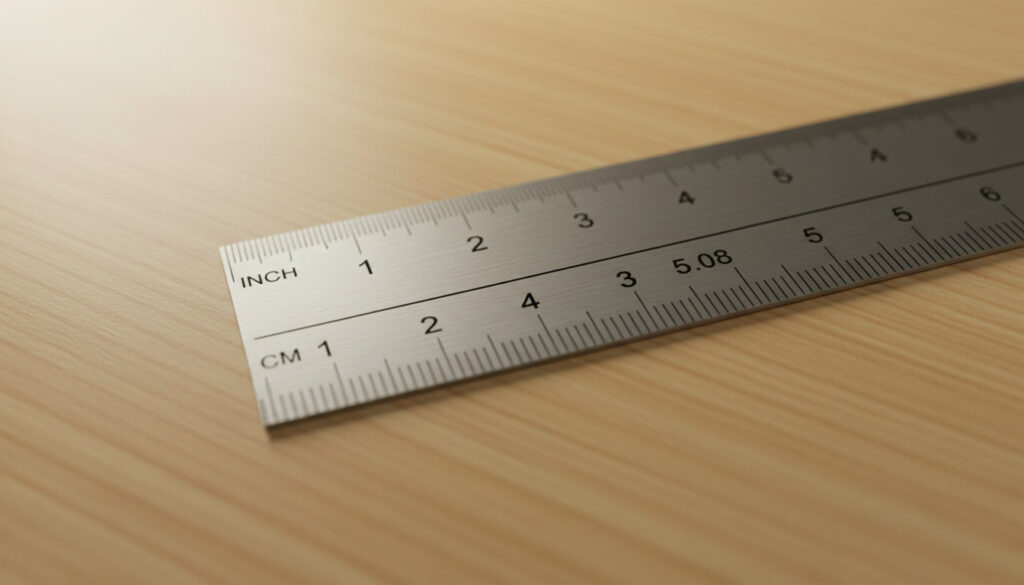
2 Inches in CM – Exact 5.08 cm Conversion Guide
Two inches equals exactly 5.08 centimeters. This precise conversion stems from the 1959 international yard and pound agreement, which standardized the inch for scientific and commercial use across the United States, United Kingdom, Canada, Australia, New Zealand, and South Africa.
Unlike rough approximations that round 2 inches to 5 centimeters, the exact figure of 5.08 centimeters carries legal and technical weight. International manufacturing standards, consumer electronics specifications, and textile measurements all rely on this unambiguous definition maintained by national metrology institutes.
The conversion rests on a single fixed relationship: one inch equals exactly 2.54 centimeters. Multiplying this base unit by two yields the precise metric equivalent without rounding or estimation errors.
How Many Centimeters Are in 2 Inches?
- Exact: 5.08 cm
- Formula: inches × 2.54
- 1 inch: 2.54 cm
- Precision: Exact, no rounding
The value 5.08 centimeters represents the definitive metric measurement for 2 inches. This figure appears in engineering tolerances, screen size specifications, and international shipping standards where imprecision could result in fitting failures or regulatory non-compliance.
Key facts regarding this conversion include:
- The conversion is mathematically exact, not an approximation
- Established by the 1959 international yard and pound agreement
- Recognized by the U.S. National Institute of Standards and Technology (NIST) and international standards bodies
- Replaced earlier national variations where the U.S. and British inches differed slightly
- Enables dual-labeling of products for global markets
- Maintains consistency across scientific research and industrial manufacturing
- Remains static regardless of application context or geographic location
| Inches (in) | Centimeters (cm) |
|---|---|
| 1 | 2.54 |
| 2 | 5.08 |
| 3 | 7.62 |
| 4 | 10.16 |
| 5 | 12.70 |
| 6 | 15.24 |
| 7 | 17.78 |
| 8 | 20.32 |
| 9 | 22.86 |
| 10 | 25.40 |
| 11 | 27.94 |
| 12 | 30.48 |
What Is 1 Inch in Centimeters?
The International Standard Definition
One inch equals exactly 2.54 centimeters. The 2026 NIST Handbook 44, Appendix C explicitly defines this relationship, noting that 1 millimeter equals 0.0393701 inch exactly, which implies the 2.54 centimeter equivalence.
This definition supersedes previous U.S. survey definitions. NIST notes the shift to the international foot, defined as exactly 0.3048 meters, which supports the inch’s exact metric equivalence. The standardization resolved discrepancies that previously existed between English-speaking nations.
Historical Variations Before 1959
Prior to 1959, inches varied slightly by country. The U.S. survey inch historically differed from the international inch used in Commonwealth nations. Switzerland once employed an inch measuring 3 centimeters in the 19th century. These variations created significant challenges for precision engineering and international trade.
Since 1959, the inch has been defined internationally as exactly 2.54 centimeters. This fixed definition eliminated the confusion caused by slightly differing national standards and established a single reference point for global manufacturing.
How Do You Convert Inches to CM?
Multiplication Method
Convert inches to centimeters by multiplying the inch value by 2.54. The formula is: centimeters = inches × 2.54. For 2 inches, the calculation is 2 × 2.54 = 5.08 centimeters.
This exact formula appears in NIST metric conversion resources. Unlike older conversion tables that listed 1 inch as approximately 2.53999 centimeters, modern standards require the exact 2.54 multiplier.
Division for Reverse Conversion
To convert centimeters to inches, divide the centimeter value by 2.54. The formula is: inches = centimeters ÷ 2.54. For example, 5.08 centimeters divided by 2.54 equals exactly 2 inches.
To verify your conversion, multiply the inch value by 2.54. For 2 inches: 2 × 2.54 = 5.08 centimeters exactly. No rounding is necessary for standard calculations, though practical applications may round to 5.1 cm for display purposes.
Inches to CM Conversion Chart
The following chart extends the conversion range to include common fractional and whole-inch measurements. Values derive directly from the 2.54 centimeter standard.
| Inches (in) | Centimeters (cm) |
|---|---|
| 0.5 | 1.27 |
| 1.0 | 2.54 |
| 1.5 | 3.81 |
| 2.0 | 5.08 |
| 2.5 | 6.35 |
| 3.0 | 7.62 |
| 4.0 | 10.16 |
| 5.0 | 12.70 |
| 6.0 | 15.24 |
| 12.0 | 30.48 |
For 2.5 inches, the exact conversion is 6.35 centimeters. Twelve inches equals exactly 30.48 centimeters, which corresponds to the international foot standard of 0.3048 meters.
Avoid using 2.5 cm as the equivalent for 1 inch in precise work. While numerically close, this 0.04 cm difference accumulates significantly over larger measurements, potentially causing fitting errors in manufacturing, construction, or sizing applications.
How Was the Inch-Centimeter Standard Established?
The fixed relationship between inches and centimeters emerged from a specific historical agreement rather than gradual metrological evolution. The standardization process followed a clear sequence:
- : The international yard and pound agreement established 1 inch = 2.54 cm exactly among six English-speaking nations.
- : The United States adopted the international inch, superseding the previous U.S. survey inch definition.
- : Commonwealth nations including the United Kingdom, Canada, Australia, New Zealand, and South Africa implemented the standard.
- : The meter’s redefinition via the speed of light solidified the SI foundation underpinning the 2.54 cm standard, ensuring compatibility with BIPM SI unit frameworks.
What Is Certain About These Conversions?
| Established Information | Information to Avoid |
|---|---|
| 1 inch = 2.54 cm exactly (international agreement) | Approximating 1 inch as 2.5 cm |
| 2 inches = 5.08 cm without rounding | Assuming 2 inches equals exactly 5 cm |
| Defined in NIST Handbook 44, Appendix C | Using pre-1959 conversion tables |
| Applies universally across all applications | Regional variations in the inch definition |
Why Does Precise Conversion Matter?
Exact conversion between inches and centimeters prevents costly errors in global manufacturing. A 0.08 centimeter discrepancy in a 2-inch component might seem negligible, but multiplied across thousands of units or integrated into precision machinery, such variances compromise functionality.
Consumer products demonstrate this necessity clearly. Footwear sizing, such as the measurements found in the Air Force 1 White Sizing, Fit and Care Guide, relies on exact length conversions to ensure consistent fit across international markets. Similarly, technical specifications for athletic equipment like those detailed in the Puma Deviate Nitro Elite 3 Specs, Performance and Review require precise dimensional data for component compatibility.
Display technology provides another critical application. Screen diagonal measurements marketed in inches must convert precisely to centimeters for international labeling requirements. A 2-inch screen equals exactly 5.08 centimeters, not 5.0 centimeters, affecting bezel calculations and housing dimensions.
Where Do These Standards Originate?
The National Institute of Standards and Technology maintains the authoritative U.S. definition of these units. NIST’s current unit definitions explicitly confirm the exact relationships between customary and metric measurements.
1 millimeter (mm) = 0.001 meter (exactly) = 0.039 370 1 inch (exactly)
— NIST Handbook 44, Appendix C – General Tables of Units of Measurement
The International Bureau of Weights and Measures (BIPM) oversees the SI system, which provides the metric foundation for these conversions. While BIPM does not directly define the inch as a non-SI unit, the 2.54 centimeter definition aligns with SI through the 1959 agreement. BIPM’s historical SI documentation traces the evolution of measurement standards that underpin these exact conversions.
Key Takeaways on 2 Inches to CM
Two inches equals exactly 5.08 centimeters based on the international standard defining 1 inch as 2.54 centimeters. This conversion, established in 1959 and maintained by NIST, eliminates previous national variations and ensures precision across engineering, manufacturing, and consumer applications. For related measurement standards in consumer products, see the Puma Deviate Nitro Elite 3 Specs, Performance and Review.
Common Questions
How many cm is 3 inches?
Three inches equals exactly 7.62 centimeters, calculated as 3 × 2.54.
Is 2 inches exactly 5 cm?
No. Two inches equals 5.08 centimeters exactly. Using 5 cm represents an approximation that introduces a 0.08 centimeter error.
What is 2.5 inches in cm?
2.5 inches equals exactly 6.35 centimeters.
How do I convert fractional inches to centimeters?
Convert the fraction to a decimal, then multiply by 2.54. For example, 1/2 inch = 0.5 × 2.54 = 1.27 cm.
How many millimeters is 2 inches?
Two inches equals exactly 50.8 millimeters, since 1 inch = 25.4 mm exactly.
Why is the conversion factor 2.54 and not 2.5?
The 2.54 factor derives from the 1959 international yard and pound agreement, which standardized the inch to align precisely with metric units for scientific and engineering consistency.
Where is this standard officially documented?
NIST documents this standard in Handbook 44, Appendix C, which defines 1 inch as exactly 25.4 millimeters or 2.54 centimeters.
More related posts
 John Travolta Now: Tragedy, Health, and Life After Kelly Preston
 Wayne Gretzky: Legacy, Controversies, and Net Worth
 PIP Medical Conditions List UK: Eligibility & How to Apply
 JFK Junior: Life, Death, and Unanswered Questions | Full Guide
 Black Panther: Marvel Movie vs Real Animal – Facts, Cast & Future
 Call of Duty Black Ops 6 – Complete Release Guide
 Petrol Stations with Fuel Near Me: Prices & Quality Compared
 Virat Kohli: Net Worth, Ex-Girlfriends & Retirement 2025