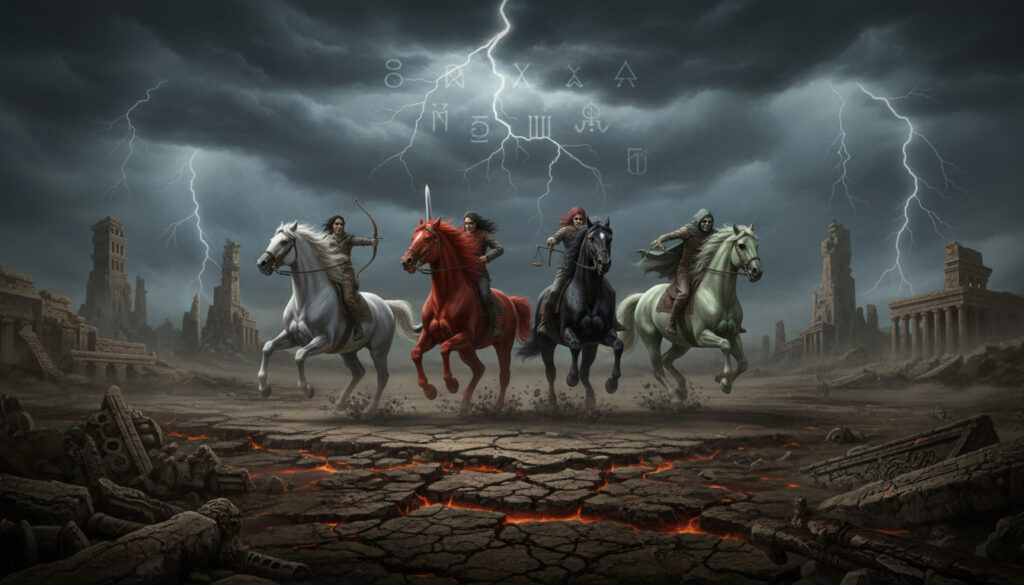
4 Horsemen of the Apocalypse – Names, Colors & Meanings
The Four Horsemen of the Apocalypse emerge in Revelation 6:1-8 as the Lamb opens the first four seals of a divine scroll. Each rider—Conquest, War, Famine, and Death—appears in strict sequence, unleashing specific judgments upon the earth. These figures stand among the most recognizable symbols in biblical prophecy, representing a progression of devastation that culminates in the death of one quarter of humanity.
Biblical scholarship identifies the horsemen as agents of divine judgment rather than literal mounted warriors. The text describes them answering the call of living creatures, with the first rider carrying a bow and crown, the second wielding a great sword, the third bearing scales, and the fourth named explicitly as Death with Hades following behind.
Interpretations vary significantly across theological traditions. Some view the sequence as a prediction of end-times tribulation, while others see an allegory for spiritual forces active throughout history. The imagery has permeated Western culture, appearing in medieval art, heavy metal music, and apocalyptic fiction, often detached from its original scriptural context.
Who Are the Four Horsemen of the Apocalypse?
Conquest
Bow and crown
War
Great sword
Famine
Scales
Death
Hades follows
- Only the fourth rider receives an explicit name in the text: Death.
- The white horse rider carries a bow, distinguishing him from the sword-bearing warrior who follows.
- Each horseman responds to the command “Come!” issued by one of the four living creatures.
- The progression moves from conquest to war to famine to death, representing escalating severity.
- The pale horse’s color derives from the Greek chloros, indicating a sickly yellowish-green associated with decay.
- The fourth rider possesses authority over precisely one quarter of the earth’s population.
- Old Testament parallels in Zechariah 6 connect colored horses to spirits patrolling the earth.
| Horseman | Horse Color | Primary Symbol | Biblical Reference | Authority Granted |
|---|---|---|---|---|
| First | White | Bow and crown | Revelation 6:2 | Conquest and expansion |
| Second | Red/Fiery | Great sword | Revelation 6:4 | Removal of peace, mutual slaughter |
| Third | Black | Scales | Revelation 6:5-6 | Economic scarcity; inflated grain prices |
| Fourth | Pale Green | Named Death | Revelation 6:8 | Kill 1/4 of earth via sword, famine, plague, beasts |
| Sequence | Fixed order | None | Revelation 6:1-8 | White → Red → Black → Pale |
| Status | Symbolic | Spirit beings | Zechariah 6 parallels | Instruments of divine judgment |
Are the Four Horsemen Named in the Bible?
Scripture explicitly names only one rider. Revelation 6:8 identifies the fourth figure as Death, with Hades personified as a separate entity following closely behind. The first three horsemen remain unnamed, identified solely by their actions and the color of their mounts. The white horse rider functions as a conqueror, the red horse rider as a warmonger, and the black horse rider as a bringer of famine.
What Do the Four Horsemen Represent?
Theological traditions offer competing interpretations of what each horseman symbolizes. The futurist view dominant in many evangelical circles interprets the white horse rider as the Antichrist, the red horse as global warfare, the black horse as economic collapse, and the pale horse as mass death during the Great Tribulation.
What Does the White Horse Symbolize?
Conflicting interpretations divide scholars regarding the first rider. The majority position holds that the bow and crown indicate deceptive conquest or the Antichrist’s false peace. However, Jehovah’s Witnesses and some idealist theologians interpret this figure as Christ or the spread of the gospel, contrasting this rider with the true white horse rider of Revelation 19. The historicist view suggests the early church’s corruption into a conquering political power.
No consensus exists regarding the white rider’s identity. The conqueror interpretation remains most common among futurist scholars, while other traditions view the same imagery as representing either righteous spiritual warfare or deceptive political power.
What Does the Pale Horse Represent?
The fourth horseman personifies mortality itself. Unlike his predecessors who introduced conditions leading to death, this figure embodies the end state. His pale green coloration reflects the hue of corpses and decaying flesh. He receives power to execute one quarter of Earth’s population through four specific means: military violence, starvation, epidemic disease, and predatory animals.
What Are the Colors and Order of the Four Horsemen’s Horses?
The sequence of appearance follows a rigid pattern recorded in Revelation 6: white, fiery red, black, and pale green. Each color carries deliberate symbolic weight drawn from ancient Mediterranean visual language. White suggests victory and purity, red evokes bloodshed and fire, black indicates darkness and death, while pale green conveys sickness and decomposition.
Where in the Bible Are the Four Horsemen?
The primary account appears in Revelation 6:1-8, embedded within the larger narrative of the seven-sealed scroll. The passage follows John’s vision of the throne room and precedes the opening of the fifth and sixth seals. Living creatures surrounding the throne issue the summons that releases each rider.
The Significance of the Sequence
The order suggests escalating catastrophe. Conquest disrupts political order, war follows conquest’s breakdown of peace, famine results from war’s destruction of agriculture, and death consolidates these preceding judgments. Biblical symbolism connects this progression to Old Testament patterns where colored horses represent spirits executing divine patrols across the earth.
Popular culture frequently depicts Pestilence as a distinct horseman, often replacing Conquest. Biblical texts confirm that plague and disease constitute methods employed by the fourth rider rather than a separate entity. Revelation 6:8 lists plague alongside sword, famine, and wild beasts as Death’s instruments.
How Are the Four Horsemen Interpreted Across Theological Traditions?
Interpretive frameworks divide roughly into four major categories. The futurist understanding places these events during a future Great Tribulation. The historicist view maps the horsemen onto church history, seeing the white horse as early Christianity, the red as pagan Roman persecution, the black as medieval spiritual famine, and the pale as subsequent widespread death. To understand the nuances of these interpretations, it’s helpful to write mission and vision statements.
Idealist interpreters view the figures as timeless spiritual realities recurring throughout history. Preterist scholars, conversely, locate the fulfillment in first-century events such as the Jewish-Roman wars. Jehovah’s Witnesses interpret the riders as specific events beginning in 1914, with the white horse representing Christ’s enthronement.
Medieval artists including Albrecht Dürer established the visual iconography now associated with these figures. Modern adaptations in film, television, and gaming frequently reimagine the horsemen as supernatural villains or metaphors for societal collapse, often departing significantly from the biblical narrative while retaining the apocalyptic symbolism.
What Is the Chronological Sequence of the Four Horsemen?
-
First Seal (White)
The Lamb opens the first seal. A living creature cries “Come!” The white horse appears with its crowned rider bearing a bow, riding forth to conquer (Revelation 6:1-2).
-
Second Seal (Red)
The second seal opens. The fiery red horse emerges. Its rider receives a great sword and authority to remove peace from the earth, causing people to slaughter one another (Revelation 6:3-4).
-
Third Seal (Black)
The third seal reveals the black horse. The rider holds scales while a voice announces economic conditions: a quart of wheat for a day’s wages, with oil and wine protected from damage (Revelation 6:5-6).
-
Fourth Seal (Pale)
The fourth seal unleashes the pale green horse. The rider named Death appears with Hades following, granted power over one quarter of the earth to kill by sword, famine, plague, and wild beasts (Revelation 6:7-8).
What Do Scholars Know for Certain About the Four Horsemen?
| Established Information | Information That Remains Unclear |
|---|---|
| Four riders appear sequentially in Revelation 6:1-8 | Whether the white rider represents Christ or the Antichrist |
| Only the fourth rider is explicitly named “Death” | Whether these describe literal future events or ongoing spiritual realities |
| Colors follow the order: white, red, black, pale green (chloros) | Specific historical events that might fulfill these prophecies |
| Pestilence is included in the fourth rider’s methods, not a separate horseman | The precise identity of the “beasts of the earth” mentioned in Revelation 6:8 |
| The progression represents conquest → war → famine → death | Whether the “fourth of the earth” applies to a specific period or the complete tribulation |
What Is the Historical and Theological Context?
The imagery draws from apocalyptic literary traditions contemporary to the first century. The concept of colored horses carrying divine messages appears in Zechariah 6, where they patrol the earth as spirits. Early church fathers and medieval theologians consistently interpreted these figures as symbolic of divine judgment upon human wickedness rather than literal cavalry.
The historical impact extends beyond theology into public health responses. During the Black Death, Europeans frequently identified the plague with the pale horse rider. This interpretation shaped religious art, penitential practices, and societal responses to pandemic disease for centuries. What Is a Normal Heart Rate
What Do Primary Sources Say?
“I looked, and there before me was a white horse! Its rider held a bow, and he was given a crown, and he rode out as a conqueror bent on conquest.”
— Revelation 6:2, NIV
“I looked, and there before me was a pale horse! Its rider was named Death, and Hades was following close behind him. They were given power over a fourth of the earth to kill by sword, famine and plague, and by the wild beasts of the earth.”
— Revelation 6:8, Biblical Source
What Is the Lasting Significance of the Four Horsemen?
The Four Horsemen remain central to Christian eschatology, symbolizing the inevitable consequences of human sin and divine judgment. Whether interpreted as future prophecy, historical allegory, or spiritual archetypes, they continue to shape theological discourse and cultural representations of apocalypse. Their imagery serves as a stark reminder of mortality and the biblical assertion that history moves toward a divinely appointed culmination. What Is Cardiovascular Disease
Frequently Asked Questions
Why does the black horseman spare oil and wine?
The voice in Revelation 6:6 commands protection for oil and wine while wheat and barley prices inflate dramatically. This suggests selective scarcity where luxury goods remain available while staples become unaffordable, indicating economic collapse that preserves wealth for some while devastating others.
What is the Greek word for “pale” describing the fourth horse?
The text uses chloros, meaning pale green or yellowish-green. This coloration suggests sickness, corpses, and decay rather than the ghostly white often depicted in popular art.
How do the Four Horsemen relate to the Great Tribulation?
Futurist interpreters view the horsemen as inaugurating the Tribulation, with the white horse representing the Antichrist’s rise to power and the subsequent riders escalating the chaos of that period.
Do the Four Horsemen appear literally or symbolically?
Theological consensus treats them as symbolic visions representing spiritual realities and historical judgments, though some literalist traditions anticipate actual mounted figures during end-time events.
What is the difference between Revelation 6 and Revelation 19 white horses?
Revelation 6 features a rider with a bow bent on conquest, while Revelation 19 depicts Christ on a white horse with a sword from his mouth and eyes like blazing fire, representing righteous judgment rather than conquest.
More related posts
 Danny DeVito: Height, Polio Diagnosis, and Personal Life Guide
 Call of Duty Black Ops 6 – Complete Release Guide
 Olivia Newton-John: Death, Net Worth, and John Travolta
 Susannah Fielding: Biography, Career, Net Worth & More
 Dow Jones Index Live Today: DJIA Real-Time Price & News
 Billy Hargrove: Victim or Villain in Stranger Things
 Dan Burn: Height, Position, Injury, and Latest News (2025)