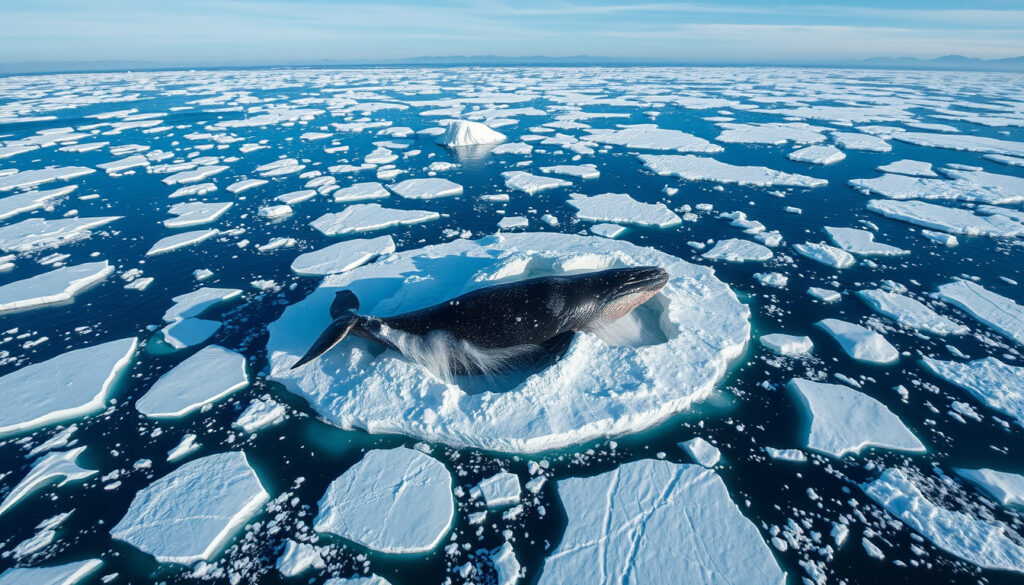
Drone Footage Captures Greenland Bowhead Whale Breaking Ice
Researchers in Greenland recently caught on drone camera a behavior that reshapes what scientists thought they knew about bowhead whales: these 20-meter animals don’t just survive Arctic winters—they actively smash through sea ice thick enough to walk on to breathe.
Location: Disko Bay, Greenland · Event Captured: Bowhead whale smashing through ice · Footage Source: Drone video by researchers · Historical Find: Harpoon from 1800s discovered in 2007
Quick snapshot
- Bowhead whales can break through ice up to 60cm thick (Discover Wildlife)
- Fredrik Christiansen from Aarhus University captured drone footage in Disko Bay (Discover Wildlife)
- WWF conducted what is believed to be the first intensive drone study of bowhead whales (WWF Arctic)
- Exact age of the specific whale captured in the footage
- How frequently these ice-breaking events occur across the population
- Whether all bowhead whales use the same technique or if it varies by individual
- 1800s: Harpoon embedded in bowhead during commercial whaling era
- 2007: Ancient harpoon discovered in hunted bowhead specimen
- 2016: WWF releases rare drone footage of undisturbed bowhead behaviors
- 2025: Disko Bay ice-breaking drone video shared publicly
- Researchers plan additional drone deployments to study winter behavior
- Climate change effects on Arctic ice patterns may alter bowhead surfacing zones
- Long-term population monitoring will track adaptation strategies
Key specifications for bowhead whales documented in recent research:
| Attribute | Details |
|---|---|
| Species | Balaena mysticetus |
| Habitat | Arctic waters, Greenland |
| Notable Event | Ice-breaking surfacing in Disko Bay |
| Maximum Ice Broken | Up to 60cm thick |
| Maximum Length | Up to 20 meters |
| Harpoon Discovery Year | 2007 |
| Footage Date | Recent researcher drone capture |
Bowhead whale breaking ice
The footage that stunned marine biologists shows a bowhead whale launching its massive head through a layer of sea ice—creating a breathing hole called a “hummock” in the process. Fredrik Christiansen, a researcher at Aarhus University who captured the drone video in Disko Bay, Greenland, documented behavior that most people never see.
Drone footage in Disko Bay
Christiansen shared the video on social media, where it quickly gathered attention for its remarkable clarity. The footage shows not just the physical act of breaking ice, but the whale’s deliberate technique—using its enormous head as a battering ram against frozen seawater.
Ice-smashing behavior explained
Scientists have long known that bowhead whales need to surface through ice to breathe. What the drone footage reveals is the raw power required: ice thickness the whales break ranges from 20cm to 60cm, with the animals using momentum and skull strength to shatter the frozen surface. In 1985, Alaska researchers observed bowheads surfacing through ice just 14-15cm thick that could support 500kg of weight—a testament to the pressure these animals generate.
The bowhead’s specially adapted skull, which can comprise up to a third of its body length, gives it the mechanical advantage needed for this kind of brute-force surfacing—a survival skill that no other whale species can match.
Drone captures Greenland ice tearing open to reveal humongous animal beneath
The viral moment when Greenland’s sea ice tore open to reveal a bowhead whale beneath captured something that traditional boat-based research never could—a close, undisturbed view of behavior in the animals’ natural habitat.
Qeqertarsuaq footage details
The Disko Bay location where Christiansen filmed features rugged ice surfaces, including formations near the Eqi Glacier. Stock footage from Getty Images also documents whales surfacing near breaking icebergs in this region, confirming the area as a hotspot for bowhead activity during colder months.
Arctic WWF rare sighting
The World Wildlife Fund’s Arctic program released separate drone footage in 2016 that captured previously unseen behaviors: rolling, breaching, and social interactions among the Eastern Canada-West Greenland bowhead population. According to WWF, this effort represents what is believed to be the first intensive drone study of bowhead whales, providing Canada’s largest marine mammals with unprecedented documentation.
Drone technology solves a fundamental problem in whale research: the animals alter their behavior when boats approach. With drones, researchers observe natural behaviors without disturbance, revealing patterns that decades of vessel-based observation missed entirely.
Bowhead whale size
Bowhead whales rank among the largest marine mammals on Earth, yet their size becomes almost abstract until you see one smashing through ice. Understanding their dimensions helps explain why they’re uniquely equipped for Arctic survival.
Dimensions and weight
Adult bowhead whales can reach lengths of up to 20 meters—roughly the length of a school bus—with females typically larger than males. Their weight can exceed 100 tonnes, making them one of the heaviest animals ever to exist. What’s less known is their remarkable blubber layer, which can exceed 50cm in thickness, providing both insulation and energy reserves during fasting periods.
Comparison to other whales
While blue whales and fin whales grow longer, the bowhead’s advantage lies in its robust build and specialized Arctic adaptations. Unlike migrate-to-warmer-waters species, bowheads remain year-round in Arctic waters, making their ice-breaking ability non-negotiable for survival.
“Weighing up to 100 tonnes, bowheads are built for the freeze—not for escape. Their entire anatomy evolved around surviving where other whales simply cannot.”
— Fredrik Christiansen, Aarhus University (marine mammal researcher)
Bowhead whale harpoon discovery
Perhaps the most striking evidence of bowhead whale longevity and resilience comes from a discovery that linked modern science with a dark chapter of maritime history.
2007 findings
In 2007, researchers analyzing a hunted bowhead whale made a remarkable find: an arrow-style harpoon head embedded in the animal’s blubber. Carbon dating confirmed the harpoon dated to the 1800s, meaning the whale had survived a whaling strike more than a century before being captured in 2007.
1800s harpoon embedded
Commercial whaling in the 1800s nearly drove bowhead populations to extinction. The harpoon style found in the 2007 specimen—arrow-shaped and made of iron—matches 19th-century hunting technology, providing concrete evidence of how close humans came to eliminating these animals before conservation efforts began.
A whale that survived a harpoon in the 1800s—decades before a 2007 hunt finally ended its life—represents both the resilience of bowhead populations and the legacy of commercial whaling’s near-fatal impact on Arctic marine mammals.
Whale with a harpoon
The story of the 2007 harpoon discovery circulated widely in media and scientific circles, but questions persist about the exact circumstances and what the finding means for understanding bowhead longevity.
Historical whaling evidence
The embedded harpoon serves as physical proof of the bowhead whale’s remarkable lifespan. Bowheads are known to live over 200 years, making them among the longest-lived mammals on Earth. The 1800s harpoon demonstrates that this particular whale survived a direct strike decades before modern research methods existed.
Pictures and stories
Documentation of the 2007 specimen spread through scientific publications and conservation advocacy materials. While the images primarily show the harpoon head itself rather than the living whale, they remain powerful evidence of bowhead whales’ encounters with industrial-era hunting.
To learn more about bowhead whale lifespan and the factors contributing to their remarkable longevity, see our guide to bowhead whale lifespan.
Timeline of key discoveries
What we know and what we don’t
Confirmed facts
- Drone footage captured bowhead whale breaking through ice in Disko Bay, Greenland
- Bowhead whales can break through ice up to 60cm thick using their massive skulls
- Harpoon from the 1800s was recovered from a bowhead whale in 2007
- Fredrik Christiansen from Aarhus University filmed the ice-breaking behavior
- WWF conducted what is believed to be the first intensive drone study of bowheads
- Bowhead whales can grow up to 20 meters in length
- Scientific name: Balaena mysticetus
Still unclear
- Exact age of the individual whale in the 2025 Disko Bay footage
- Whether all bowheads use the same skull-based technique or if approaches vary
- How climate-driven changes in Arctic ice patterns will affect bowhead breathing hole locations
- Frequency of ice-breaking events across the broader population
What researchers are saying
“Bowhead whales are perfectly designed for this. Their skull alone can be a third of their body length, giving them the mechanical advantage to smash through ice that would trap any other whale species.”
— Fredrik Christiansen, Aarhus University (marine mammal researcher specializing in Arctic cetaceans)
“Drones have opened a window we never had before. We’re seeing behaviors that have been hidden from science because boats scare these animals back under the ice.”
— WWF Arctic program (conservation organization documenting Eastern Canada-West Greenland population)
Related reading: bowhead whale lifespan
Frequently asked questions
Why is bowhead whale drone footage rare?
Bowhead whales live in remote Arctic waters where ice cover limits research vessel access for much of the year. Drones solve this problem by allowing observation without boat disturbance, but deploying them in freezing conditions with shifting ice presents significant logistical challenges.
How do bowhead whales breathe under ice?
Bowhead whales cannot breathe through ice—they must break through to create a breathing hole. Using their massive, reinforced skulls, they launch upward through ice up to 60cm thick, then use the resulting hummock as a temporary breathing vent until they need to resurface again.
What makes bowhead whales long-lived?
Bowhead whales are among the longest-lived mammals, with some individuals exceeding 200 years. Their longevity is linked to their slow metabolism, Arctic isolation from many predators, and robust cellular repair mechanisms that researchers are still studying.
Where can I watch the Greenland bowhead whale video?
The ice-breaking footage captured by Fredrik Christiansen was shared publicly on social media platforms. Stock footage is also available through Getty Images, showing bowheads surfacing near breaking icebergs in Disko Bay.
Are bowhead whales endangered?
Bowhead whales were nearly hunted to extinction during the 1800s commercial whaling era. Today, several populations remain depleted, though the Eastern Canada-West Greenland population has shown signs of recovery. They are still protected under international conservation agreements.
How has drone technology helped whale research?
Drones allow researchers to observe marine mammals without the behavioral changes caused by approaching vessels. For bowhead whales especially, drones capture behaviors like ice-breaking, rolling, and social interaction that boat-based researchers simply cannot witness without disturbing the animals.
What is the difference between bowhead and other Arctic whales?
Unlike narwhals and belugas that migrate south in winter, bowhead whales remain in Arctic waters year-round. This makes them the only great whale permanently adapted to ice-covered seas—and the only species that must actively break ice to breathe throughout the winter months.
For Arctic conservation groups monitoring bowhead populations, the implications are straightforward: continued funding for drone-based research, or accept that critical behavioral data will remain hidden. For climate scientists tracking sea ice loss, bowhead ice-breaking footage provides a stark baseline—these animals evolved to punch through frozen seawater, and any reduction in their ability to do so signals ecosystem stress that extends far beyond a single species.
More related posts
 Valerie Mahaffey Dead at 71: Emmy Winner Dies of Cancer
 Miles Teller: Biography, Accident, Net Worth, and FAQs
 Vinnie Jones: Football Career, Movies, Net Worth, Documentary
 Dennis Rodman: NBA Legend, Net Worth, and Life Today
 Chris Tucker: Net Worth, Quit Reason and Comeback 2024
 David Gandy: Biography, Age, Height, Net Worth & Personal Life
 Bruno Mars: Wife, Ethnicity, Height, and Career Facts
 Jane McCarry: Biography, Still Game Role, Teaching Career