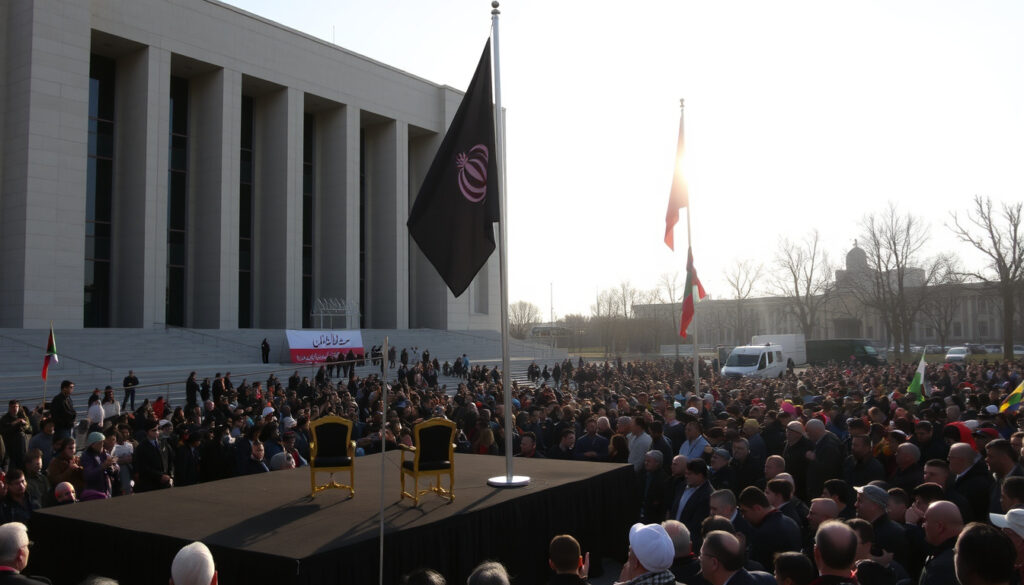
Ali Khamenei Assassinated: Death and Successor 2026
For nearly four decades, Ali Khamenei was the unchallenged anchor of Iran’s Islamic Revolution. On February 28, 2026, a coordinated US-Israeli air strike shattered that legacy, killing the 86-year-old Supreme Leader and triggering a geopolitical earthquake. This article pieces together what happened, who may succeed him, and what it means for the region.
Date of birth: April 19, 1939 ·
Date of death: February 28, 2026 ·
Age at death: 86 ·
Cause of death: Assassinated in US-Israel air strike
Quick snapshot
- Khamenei died on February 28, 2026 in a large-scale air attack by the US and Israel (Reuters)
- He was 86 years old (Britannica)
- Iran declared 40 days of national mourning (NPR)
- Exact number of casualties in the attack (Al Jazeera)
- Full list of senior officials killed alongside him (Reuters)
- Who will be the next Supreme Leader (Chatham House)
- Attack timed to coincide with a meeting of Khamenei and his inner circle (Reuters)
- Strikes began around 9:40am local time in Tehran (Al Jazeera)
- Nearly 900 strikes in the first 12 hours (Britannica)
- Assembly of Experts will choose a successor (Chatham House)
- Khamenei’s son Mojtaba is a leading contender (Wikipedia)
- US and Israel continue Operation Epic Fury campaign (Britannica)
The key facts table below draws a compact biographical portrait of Khamenei’s life and leadership.
| Full Name | Ali Hosseini Khamenei |
|---|---|
| Title | Supreme Leader of Iran |
| Born | April 19, 1939, Mashhad, Iran |
| Died | February 28, 2026, Tehran, Iran |
| Religion | Shia Islam |
| Years as Leader | 1989–2026 (37 years) |
How was Ali Khamenei assassinated?
When did the assassination occur?
The attack unfolded on the morning of February 28, 2026. According to Al Jazeera, air strikes targeting Khamenei and senior defense personnel began around 9:40am local time (06:10 GMT). Reuters reported that Israel and the United States synchronized the attack to coincide with a meeting between Khamenei and his key advisors. The fortified compound in Tehran was hit at the onset of the operation.
What was the target of the attack?
The primary target was Khamenei’s personal compound in Tehran. Reuters confirmed that satellite images reviewed by the agency showed destruction at the compound. The attack was part of Operation Epic Fury, described by Britannica as the U.S. code name for joint military operations with Israel against Iran, which began on February 28 and concluded on May 5, 2026. Nearly 900 strikes were launched in the first 12 hours.
How many people died in the attack?
Reuters reported that Israeli authorities announced Khamenei had been eliminated along with Ali Shamkhani and Mohammad Pak. The initial wave of strikes killed Khamenei and dozens of other top Iranian officials, according to Britannica. At least 12 people died in the attack, including senior military commanders, though exact numbers remained uncertain in the immediate aftermath. NPR noted that Iranian Foreign Minister Abbas Araghchi initially told NBC News that as far as he knew, Khamenei and Iran’s president were still alive earlier on Saturday.
The operation’s precision — timed to a meeting of the inner circle and executed with 30 precision munitions on a single compound — suggests intelligence penetration far deeper than previously assumed. For Iran’s security apparatus, the failure is existential.
The implication: the assassination was not a stray strike but a meticulously planned decapitation operation. The synchronization with Khamenei’s meeting indicates real-time intelligence that bypassed Iran’s vaunted security layers.
What is the religion of Ali Khamenei?
How did Khamenei become a Shia cleric?
Khamenei was born into a religious family in Mashhad, Iran, and studied Islamic theology in Qom. He was a devoted follower of Ayatollah Khomeini and became a Grand Ayatollah, the highest rank in Shia Islam. He succeeded Khomeini as Supreme Leader in 1989 after Khomeini’s death, as documented by Wikipedia and Britannica.
What is the role of a Supreme Leader in Shia Islam?
The Supreme Leader of Iran holds the highest political and religious authority in the country. Under the doctrine of Velayat-e Faqih (Guardianship of the Islamic Jurist), the leader is both the head of state and the ultimate interpreter of Islamic law. Khamenei’s title as Grand Ayatollah gave him authority over all branches of government and the military. His role included appointing the heads of the judiciary, the military, and the Guardian Council.
Khamenei’s own religious credentials were questioned early in his tenure — he was never a marja (source of emulation) for most Shia. Yet he wielded absolute power over a theocratic system that demanded religious infallibility. The contradiction was papered over by political control.
The implication: the religious authority of the Supreme Leader is the bedrock of Iran’s political system. With Khamenei gone, the legitimacy of the next leader — especially if not a widely recognized marja — may face internal resistance from the clerical establishment.
Who will succeed Ali Khamenei?
How is the Supreme Leader of Iran chosen?
The Assembly of Experts, an 88-member body of clerics elected by the public, is responsible for selecting and dismissing the Supreme Leader. Chatham House noted that the process is opaque and heavily influenced by the incumbent leader’s inner circle. No official successor had been announced as of early March 2026.
Who are the leading candidates?
Khamenei’s son, Mojtaba Khamenei, has long been considered a potential heir, according to Wikipedia. He is a mid-ranking cleric who has managed his father’s office for years. Other names include Ebrahim Raisi (if he survived the attack) and Ali Larijani. The Assembly of Experts will face intense internal debate, especially after the decapitation of the military leadership.
What is the role of the Assembly of Experts?
The Assembly convenes after the death or resignation of the Supreme Leader. It can choose a successor by a simple majority. The Guardian Council vets candidates, but the Assembly’s decisions are rarely contested publicly. The uncertainty surrounding Khamenei’s succession is unprecedented because the strike also killed several key members of the Assembly and the military elite who would have influenced the vote.
The pattern: succession in Iran has always been managed by the incumbent. For the first time, the system must choose a leader under the shadow of a devastating attack and without the guiding hand of the predecessor.
Does Ali Khamenei support Hamas?
What is Iran’s relationship with Hamas?
Under Khamenei, Iran provided financial and military aid to Hamas, the Palestinian militant group that controls Gaza. Reuters and Britannica note that Iran’s support included funding, weapons, and training. Khamenei publicly endorsed the “resistance” movement and refused to recognize Israel’s right to exist.
How did Khamenei’s support manifest?
Khamenei often used his Friday prayer sermons and official statements to call for the destruction of Israel. He backed Hamas and Hezbollah as part of Iran’s “Axis of Resistance.” The support continued until his death. NPR reported that Khamenei’s death triggered immediate reactions in Gaza and Lebanon.
If Iran’s next Supreme Leader is less ideologically committed to the Palestinian cause or is preoccupied with internal consolidation, Hamas could lose its primary state backer. Israel’s gamble with the strike may be partly aimed at fracturing the Axis of Resistance.
The trade-off: Hamas gains a martyr narrative but loses a powerful patron. The group’s ability to sustain its military operations depends heavily on Iranian resupply routes.
How many died along with Ali Khamenei?
What were the total casualties?
At least 12 people died in the attack according to initial reports, including Khamenei. Reuters named Ali Shamkhani (former secretary of the Supreme National Security Council) and Mohammad Pak (a senior military commander) among the dead. Britannica reported “dozens of other top Iranian officials” were killed in the initial wave. The exact toll remained uncertain because the compound was leveled and communications disrupted.
Who were the notable figures killed?
Beyond Khamenei, the casualties included high-ranking members of the Islamic Revolutionary Guard Corps (IRGC) and civilian advisors. Fox News initially reported that Israel was still assessing the result and had not confirmed Khamenei’s fate, but later updated with an editor’s note confirming his death hours after publication. Israeli authorities eventually announced the elimination of several leaders.
The implication: the attack was designed not just to kill Khamenei but to decapitate Iran’s decision-making and military command in a single blow. The loss of institutional knowledge and leadership continuity may be as damaging as the human toll.
Timeline: Ali Khamenei’s life and death
- April 19, 1939 — Born in Mashhad, Iran.
- 1981 — Survives an assassination attempt; loses use of right arm.
- 1989 — Succeeds Khomeini as Supreme Leader.
- 2009 — Controversial presidential election sparks mass protests.
- 2015 — Endorses Iran nuclear deal (JCPOA).
- 2020 — Soleimani assassination; heightened tensions with US.
- February 28, 2026 — Killed in US-Israel air strike.
- March 2026 — Funeral held; succession process begins.
Clarity check: What we know vs. what we don’t
Confirmed facts
- Khamenei died on February 28, 2026 (Reuters)
- Caused by a large-scale air attack by US and Israel (Britannica)
- He was 86 years old (Wikipedia)
- He had been Supreme Leader since 1989 (Britannica)
- Iran declared 40 days of mourning (NPR)
What remains unclear
- Exact number of casualties (Al Jazeera)
- Who will be the next Supreme Leader (Chatham House)
- Full list of senior officials killed (Reuters)
- Long-term geopolitical impact (Chatham House)
Voices on the assassination
Ali Khamenei, the supreme leader of Iran, has died aged 86 in a large-scale air attack on the country by the US and Israel.
He was assassinated in 2026, ending a 37-year rule that defined Iran’s post-revolutionary path.
Wikipedia
The United States and Israel launched multiple air strikes across Iran on 28 February 2026, killing Iran’s Supreme Leader.
Chatham House
For Iran, the loss of Khamenei is not just a leadership vacuum — it is the removal of the central pillar of a political system built around one man. The Assembly of Experts now faces an unprecedented choice under duress. For the United States and Israel, the strike achieved its immediate tactical goal, but the strategic consequences — from succession chaos to potential retaliation — will define the Middle East for years. For Tehran’s ruling clerics, the choice is clear: consolidate quickly with a reliable successor, or risk a power struggle that could fracture the Islamic Republic from within.
youtube.com, youtube.com, youtube.com, foxnews.com, facebook.com, youtube.com, reefbrief.com
The assassination and its aftermath are examined in the article on Ali Khameneis assassination and legacy.
Frequently asked questions
What was Ali Khamenei’s net worth?
Estimates vary widely, with some sources suggesting his family controlled billions of dollars through foundations and business interests, though no verified public accounting exists (Wikipedia).
How did Khamenei lose his arm?
He lost the use of his right arm in a 1981 assassination attempt by a bomb hidden in a tape recorder (Wikipedia).
Who was Ali Khamenei’s wife?
He was married to Khojasteh Bagherzadeh, with whom he had four children (Wikipedia).
How many children did Ali Khamenei have?
He had six children: four sons and two daughters (Wikipedia).
What was Khamenei’s role in the Iran-Iraq war?
He served as president of Iran during most of the war (1981–1989) and was a key military commander (Britannica).
Was Khamenei related to Ayatollah Khomeini?
No, they were not related by blood. Khamenei was a close protégé and succeeded Khomeini after his death (Wikipedia).
What happened to Khamenei’s remains?
His body was recovered from the compound and buried in Tehran after a funeral attended by millions (NPR).
More related posts
 Puma Deviate Nitro Elite 3 – Specs, Performance and Review
 David Tennant TV Shows: List of Roles and New Series
 Lee Sung-kyung: Age, Height, Relationships & Career Facts
 Vicky Myers: Marriage, Illness, Daughter, and Career
 PIP Medical Conditions List UK: Eligibility & How to Apply
 Sian Gibson: Career, Family, and Latest Updates
 Silver Bangles for Women: Trends, Authenticity & Buying Guide
 Megan Skiendiel: Ethnicity, Gender, Age, Health Conditions