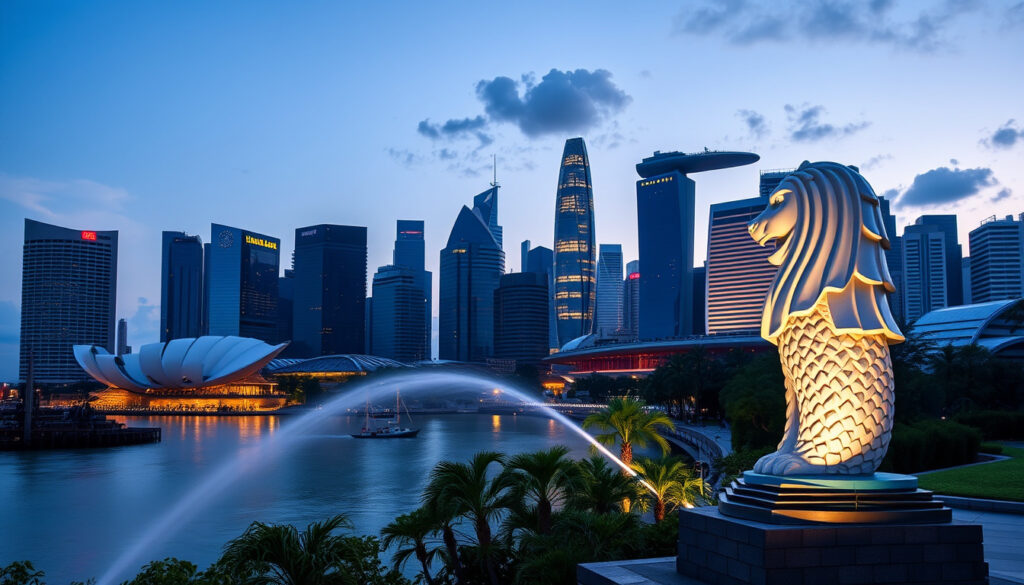
Is Singapore a Country? Status, History & Facts Explained
Singapore defies easy categorization — a gleaming city-state smaller than New York City, yet one of the world’s most prosperous nations. The short answer is yes, Singapore is absolutely a sovereign country — but the story involves a brief marriage with Malaysia, a peaceful divorce in 1965, and a reputation as a global economic powerhouse.
Status: Sovereign city-state · Independence: August 9, 1965 · Location: Southeast Asia · Capital: Singapore City · Previous Union: Malaysia (1963-1965)
Quick snapshot
- Sovereign since 1965 (U.S. Department of State)
- UN member state (Wikipedia)
- No parent country (U.S. Department of State)
- Exact population figures without latest census (Britannica)
- Specific details on 1965 separation negotiations (Facts and Details)
- 1965: Final break from Malaysia (U.S. Department of State)
- 1963-1965: Brief federation membership (U.S. Department of State)
- Ongoing ASEAN leadership role (Britannica)
- Regional influence despite small size (Britannica)
The following table summarizes Singapore’s core official attributes as recognized by international authorities.
| Attribute | Value |
|---|---|
| Official Name | Republic of Singapore |
| Government Type | Parliamentary republic |
| Independence Date | August 9, 1965 |
| Area | 683 sq km |
| Land Border | Connected to Malaysia by causeway |
Is Singapore a country or not?
Yes — Singapore is unequivocally a sovereign country. Officially known as the Republic of Singapore, it has been a fully independent nation since August 9, 1965. The U.S. Department of State lists it as a parliamentary republic with a president as chief of state and prime minister as head of government. Singapore holds a seat in the United Nations, is a member of the Commonwealth of Nations, and plays an active role in ASEAN.
City-state definition
The term “city-state” might sound unusual, but Singapore is one of only three in the world alongside Monaco and Vatican City. Britannica describes it as an island country and city-state where the national capital and the entire country occupy the same territory. Singapore dominates the strategic Strait of Malacca, one of the world’s busiest shipping lanes.
Sovereign status facts
Singapore operates with full sovereignty over its affairs — foreign policy, defense, currency, immigration, and trade — without answering to any other government. The U.S. Department of State Archive records that Singapore “withdrew from the Federation on August 9, 1965, and became an independent republic.” This wasn’t a gradual process but a definitive break.
Is Singapore a country or a city?
Both — and that’s precisely what makes Singapore fascinating. The capital is Singapore itself, as the U.S. Department of State notes, “Capital — Singapore (country is a city-state).” There’s no separate capital city to travel to because the city IS the country.
Urbanization blurring lines
With a land area of just 683 square kilometers, Singapore ranks as the smallest country by surface area in Southeast Asia. To put that in perspective: that’s roughly 1.5 times the size of Washington, D.C. Yet within this compact footprint lives a population of approximately 6.2 million people, making it one of the most densely populated nations on Earth.
City-state model
The city-state model isn’t unique to Singapore. Monaco on the French Riviera and Vatican City within Rome operate similarly — entire countries contained within single cities. What sets Singapore apart is its strategic importance: Britannica emphasizes its role as a financial hub dominating the Strait of Malacca, through which a significant portion of global trade flows.
Singapore packs more economic firepower into 683 square kilometers than countries a hundred times its size. For investors and businesses, this means concentrated opportunity — every district is essentially central business territory.
Is Singapore a part of Malaysia?
Singapore is no longer part of Malaysia — it hasn’t been since August 9, 1965. However, the relationship is more nuanced than a simple “yes” or “no” answer, because Singapore spent a brief period as part of the Malaysian federation.
Brief 1963-1965 merger
On September 16, 1963, Singapore formally joined the Federation of Malaysia, which also included Malaya, Sabah, and Sarawak. The U.S. Department of State Archive documents this formation. The merger was an attempt to unify Malay-speaking peoples under one federal government, but it lasted less than two years.
1965 separation reasons
The tensions that led to Singapore’s expulsion involved fundamental disagreements over governance philosophy. Facts and Details reports that racial issues, the question of Malay special privileges, and political representation fueled the rift. Lee Kuan Yew, Singapore’s leader, pushed for merit-based governance regardless of ethnicity, while Malaysian authorities insisted on preferential treatment for Malays.
Singapore’s National Day on August 9 commemorates its painful separation from Malaysia — a moment most Singaporeans view with complex pride. The split was negotiated hastily, with Singapore’s founding prime minister reportedly weeping at the press conference announcing independence.
What is the capital of Singapore?
The capital of Singapore is Singapore itself — there is no separate administrative center. This is because Singapore is a city-state, meaning the entire country fits within a single metropolitan area. Singapore’s National Day is celebrated on August 9 to honor the 1965 independence from Malaysia.
Singapore as its own capital
Unlike most countries where the capital is a distinct city, Singapore has no need for such a distinction. The U.S. Department of State confirms: “Capital — Singapore.” The government buildings, presidential palace, parliament, and Supreme Court all operate within the city center.
Administrative divisions
While the entire island functions as the capital, Singapore divides itself into five community development council districts for local governance purposes. These districts help manage urban planning and community services, but unlike counties or provinces in other nations, they hold no independent political power.
What country did Singapore belong to before?
Before becoming independent, Singapore was under British colonial rule for nearly a century and then briefly part of Malaysia’s federation.
British colonial era
Wikipedia records that Singapore came under British control as part of the Straits Settlements in 1867, administered directly from London. The British established Singapore as a trading post in 1819, and it grew into a vital port handling goods throughout Southeast Asia. During World War II, Japan occupied Singapore from 1942 until 1945, ending three years of British military presence in the region.
Path to independence
The path to sovereignty was gradual. The U.S. Department of State documents that Singapore gained self-governance on June 3, 1959, when a new constitution established it as a self-governing territory with its own internal government. Bernama, Malaysia’s national news agency, reports that the Federation of Malaya achieved independence from Britain on August 31, 1957 — nearly two years before Singapore followed suit. The path to sovereignty was gradual, and for more information on this period, please visit $Apa Hotel Man Under Bed.
The timeline accelerates after 1959: joining Malaysia in 1963, then separating in 1965 to become fully sovereign. EBSCO notes Singapore’s motto is “Majulah Singapura” — “Onward Singapore” — reflecting this journey from colony to independent republic.
Singapore’s four official languages — English, Malay, Mandarin, and Tamil — reflect its colonial British past and its position as a multiracial society that absorbed peoples from across Asia. The national language, Malay, was chosen partly to acknowledge the peninsula’s indigenous heritage.
Timeline of Singapore’s path to sovereignty
What we know vs. what remains unclear
Confirmed
- Singapore is a fully sovereign UN member state
- Separated from Malaysia on August 9, 1965
- Area of 683 square kilometers
- Government type is parliamentary republic
- Capital is Singapore itself
What’s unclear
- Exact current population without official census
- Specific unpublished details from 1965 separation negotiations
What experts and officials say
Capital — Singapore (country is a city-state).
U.S. Department of State (U.S. government profile)
Singapore withdrew from the Federation on August 9, 1965, and became an independent republic.
U.S. Department of State Archive (Federal government records)
The Federation of Malaya officially gained its sovereign status and was declared independent at 9:30 a.m. on the historic date of August 31, 1957.
Bernama (Malaysian national news agency)
For anyone searching “is Singapore a country,” the answer is definitive: yes, it is an independent, sovereign city-state. Unlike territories with ambiguous status, Singapore controls its own borders, issues its own currency, conducts its own foreign policy, and holds full membership in international organizations. The only unusual aspect is its physical compactness — the entire country fits within a single city, making Singapore simultaneously the smallest and most concentrated independent nation in Southeast Asia.
Related reading: largest country in the world · Eid ul Adha dates by country
While Singapore achieved full independence in 1965, ongoing debates mirror those over Scotlands country status within the United Kingdom’s complex structure.
Frequently asked questions
Is Singapore in China?
No. Despite having a majority Chinese ethnic population, Singapore is geographically located in Southeast Asia on the southern tip of the Malay Peninsula, separated from mainland Asia by the Johor Strait. It shares a land border only with Malaysia. Singapore is not and has never been part of China.
Is Singapore a Muslim country?
No. While Malay is one of four official languages and Islam is a recognized religion, Singapore is a secular, multiracial nation. Roughly 80% of Singaporeans are Buddhist, Christian, or follow other religions. No religion holds official status as a state religion.
Is Singapore more Chinese or Japanese?
Singapore’s population is predominantly ethnic Chinese (approximately 76%), but the country is neither culturally Chinese nor Japanese. Its official languages are English, Malay, Mandarin, and Tamil. The government system is based on British parliamentary democracy, and the legal system follows English common law. While influenced by both Chinese and Japanese cultures through trade and migration, Singapore has its own distinct national identity.
Can you walk between Singapore and Malaysia?
Yes, physically you can. The two countries are connected by two causeways — the Johor Causeway and the Malaysia–Singapore Second Link — that allow pedestrian and vehicle traffic between Singapore and the Malaysian state of Johor. However, you’ll need valid travel documents (passport or identity card) to cross the border, as they are separate sovereign nations.
Is Singapore a country in Asia?
Yes. Singapore is a sovereign city-state in Southeast Asia, located between the Indian Ocean and the South China Sea. It is one of the most prosperous and developed nations on the continent, with a GDP per capita that ranks among the highest in the world.
Is Singapore a country capital?
Singapore is both the country and the capital. This is the defining characteristic of a city-state. There is no separate capital city within Singapore — the entire island nation functions as the metropolitan center, with government buildings, the presidential palace, and parliament all located within the city itself.
More related posts
 Home Bargains Closing Time: Opening Hours & Store Locator Guide
 Everest Base Camp Trek: Costs, Difficulty, Itinerary & Safety (2025 Guide)
 Royal Mail Sorting Office: Parcel Hold Times & Collection
 Patrick Agyemang: Biography, Stats & Derby County Career
 What Time Does McDonald’s Breakfast End – Weekday and Weekend Hours
 Dow Jones Index Live Today: DJIA Real-Time Price & News
 FIFA Club World Cup 2025: Teams, Qualification, Schedule & Tickets
 Bruno Tonioli: Age, Net Worth, Relationship, and Career