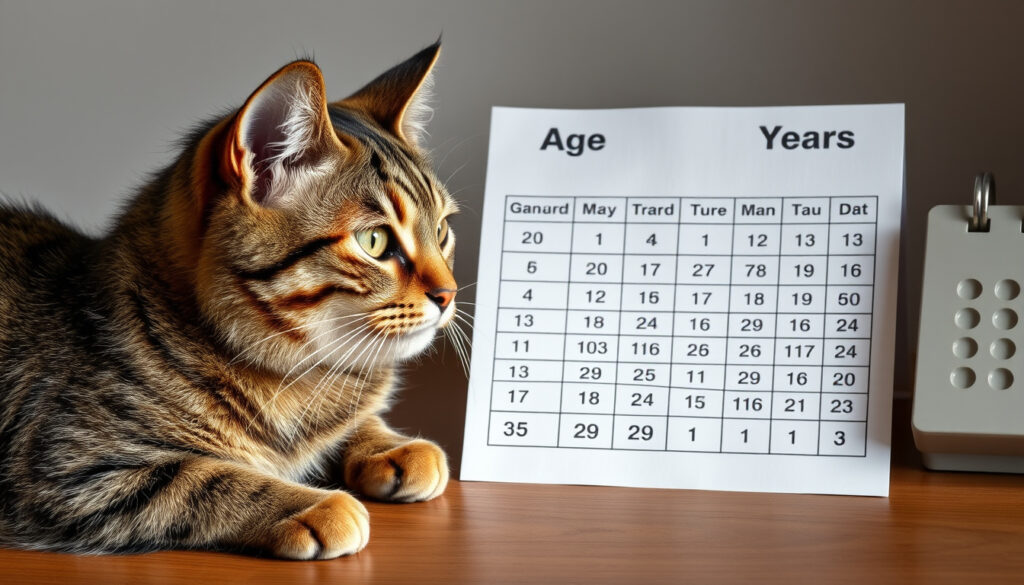
Human Cat Years: AVMA Conversion Chart & Calculator
If you’ve ever tried to figure out how old your cat is in human years, you probably found a dozen different answers. The real formula, backed by veterinarians, is more precise than the old 7-to-1 myth and it changes how you think about your cat’s life stages.
First cat year in human years: 15 · Second cat year cumulative: 24 · Each subsequent cat year: 4 · Cat age considered senior: 11 human years (approx.) · Average indoor cat lifespan: 13–17 human years
Quick snapshot
- 15 human years (AVMA (veterinary association))
- Weaning to social maturity (AVMA (veterinary association))
- Rapid growth (AVMA (veterinary association))
- 24-40 human years (AAHA (veterinary hospital association))
- Peak health and activity (AAHA (veterinary hospital association))
- Yearly vet checkups (AAHA (veterinary hospital association))
- 44-56 human years (PetMD (veterinary review site))
- Monitor weight and dental health (PetMD (veterinary review site))
- Early senior care (PetMD (veterinary review site))
- 60+ human years (AVMA (veterinary association))
- Twice-yearly vet visits (AVMA (veterinary association))
- Kidney and thyroid screening (AVMA (veterinary association))
The key numbers show a clear pattern: the first two years pack the most aging, then the rate settles down.
| Cat age | Human years (AVMA/AAHA) |
|---|---|
| 1 | 15 |
| 2 | 24 |
| 5 | 36 |
| 10 | 56 |
| 15 | 76 |
| 20 | 96 |
How Old Is My Cat in Human Years?
The most widely accepted answer comes from the AVMA and AAHA. Your cat’s first year equals about 15 human years. By the second birthday, the total reaches 24 human years. After that, each calendar year adds roughly 4 human years.
The standard formula: first two years and beyond
- Year 1: 15 human years (AVMA (veterinary association))
- Year 2: cumulative 24 human years (AAHA (veterinary hospital association) chart)
- Years 3+: +4 human years per cat year (Purina (pet nutrition brand))
This pattern is sometimes called the “15-9-4” rule: 15 the first year, 9 the second (for a total of 24), then 4 each year after.
Why the 1 cat year = 7 human years rule is wrong
The idea that one cat year equals seven human years is a holdover from dog-age thinking. Cats reach sexual maturity much faster—around six months a kitten can reproduce, which in human terms would be the equivalent of a preteen. The AVMA’s numbers reflect that rapid early development. No reputable veterinary source uses the 7x multiplier.
What this means: if someone tells you your 4-year-old cat is 28 in human years, they’re off by about 4 years. The real number is 32.
Large breeds like Maine Coons may age slightly differently, but the AVMA formula is the standard for all domestic cats. Breed-specific adjustments aren’t yet backed by enough data.
The implication: the standard formula applies broadly, but individual variation exists.
How to Tell Your Cat’s Age in Human Years
If you don’t have adoption papers, you can estimate your cat’s age using physical clues. Vets use these signs to match a cat to the chart.
Visual clues: teeth, eyes, coat, and muscle tone
- Teeth: Clean white teeth with no tartar suggest a cat under 1 year. Yellowing and tartar buildup indicate middle age (3–6 years). Missing or worn teeth point to senior status (10+ years). (PetMD (veterinary review site))
- Eyes: Clear, bright eyes are typical of youth. Clouding or iris color changes often begin around age 6–7.
- Coat: A smooth, glossy coat belongs to younger cats. Older cats tend to have coarser or thinner fur, sometimes with white patches.
- Muscle tone: A young cat is lean and muscular; older cats may lose muscle over the spine.
Using the cat age chart correctly
Match the most reliable clue (teeth are usually the strongest indicator) to the chart above. A cat with moderate tartar but clear eyes is likely in the 5–7 year range, which maps to 36–44 human years. The pattern: teeth and eyes give the most objective signals, but combined clues always beat a single one.
- Examine your cat’s teeth for tartar buildup and wear patterns
- Check the eyes for clouding or iris color changes
- Assess the coat for smoothness and gloss level
- Feel the muscle tone along the spine and hindquarters
- Cross-reference all clues against the age chart for a final estimate
The takeaway: physical clues provide a reliable proxy when adoption records are unavailable.
Cat Years to Human Years Chart
Six reference points, one clear gradient: the aging rate slows after maturity but never stops.
| Cat age | Human age | Life stage |
|---|---|---|
| 1 | 15 | Kitten |
| 2 | 24 | Young adult |
| 3 | 28 | Young adult |
| 4 | 32 | Young adult |
| 5 | 36 | Young adult |
| 6 | 40 | Young adult |
| 7 | 44 | Mature adult |
| 8 | 48 | Mature adult |
| 9 | 52 | Mature adult |
| 10 | 56 | Senior |
| 11 | 60 | Senior |
| 12 | 64 | Senior |
| 13 | 68 | Senior |
| 14 | 72 | Senior |
| 15 | 76 | Senior |
| 16 | 80 | Senior |
| 17 | 84 | Geriatric |
| 18 | 88 | Geriatric |
| 19 | 92 | Geriatric |
| 20 | 96 | Geriatric |
Sources: AAHA (veterinary hospital association), Purina (pet nutrition brand)
Cat age milestones: kitten, adult, senior
- Kitten (0–1 cat year): 0–15 human years. Weaning, rapid growth, first vaccinations.
- Young adult (2–6 cat years): 24–40 human years. Peak health, yearly vet visits sufficient.
- Mature adult (7–10 cat years): 44–56 human years. Start monitoring weight and dental health.
- Senior (11+ cat years): 60+ human years. Twice-yearly vet visits, kidney and thyroid screening.
How age relates to life stages
A 7-year-old cat sits at about 44 human years. That’s the transition from mature adult to early senior, and it’s the right time to switch to a senior diet and schedule bi-annual checkups. A 15-year-old cat is roughly 76 human years—geriatric care territory.
Senior cats (11+ cat years) have a 30% chance of developing kidney disease. Early detection through semi-annual blood work can add years of quality life. (AVMA (veterinary association))
The pattern: life stage transitions are predictable, making proactive care possible.
What Is the 3-3-3 Rule for Cats?
The 3-3-3 rule isn’t about age conversion—it describes how a new cat adjusts to a home. But it’s often asked alongside age questions because new owners want to understand their cat’s behavior and health stage.
The 3-3-3 rule for new cat adoption adjustment
- 3 days: The cat decompresses—hides, eats little, may not use the litter box normally.
- 3 weeks: The cat settles into a routine, starts exploring, and shows its real personality.
- 3 months: The cat feels fully at home and trusts its humans.
If you’ve just adopted a cat, wait until the 3-month mark before trying to assess its age via behavior. Stress can mask dental and coat clues.
A scared 4-year-old cat may act like a kitten; a confident 12-year-old may act like a spring chicken. Use physical clues, not personality, to estimate age.
What this means: behavior is an unreliable age indicator until the cat is fully settled.
Common Misconceptions About Cat Aging
Several myths persist. Here are the ones that cause the most confusion for cat owners.
Is 4 human years old for a cat?
No. A 4-year-old cat is about 32 in human years—still a young adult in peak condition. The confusion comes from the old 7x rule, which would make a 4-year-old cat 28, relatively young. But 32 is not old either; it’s roughly equivalent to a human in their early thirties.
The silent killer: kidney disease in older cats
Chronic kidney disease affects up to 30% of cats over 10 (roughly 56+ human years). (PetMD (veterinary review site)) It’s called the silent killer because symptoms—increased thirst, weight loss—are subtle until late stages. Knowing your cat’s human-age equivalent helps you schedule screening at the right time.
What this means: every cat owner should know their cat’s human age by 10 cat years (56 human years) to start semi-annual kidney panels.
Timeline signal: how aging unfolds
- 0-1 cat year: Kittenhood: rapid development, weaning, first vaccinations.
- 2 cat years: Social maturity; equivalent to 24 human years.
- 7 cat years: Onset of senior stage; annual vet checks become semi-annual.
- 11 cat years: Senior classification; increased risk of kidney disease.
- 15+ cat years: Geriatric; require specialized diet and monitoring.
Confirmed facts vs. what’s unclear
Confirmed facts
- First cat year = 15 human years (AVMA consensus)
- Second cat year = 9 additional human years (cumulative 24)
- AAHA chart shows 10 cat years = 56 human years, 15 cat years = 76 human years
What’s unclear
- Each subsequent year = 4 human years (approximate)
- Exact conversion for large cat breeds (e.g., Maine Coon) may differ slightly
- Individual health and genetics alter the pace of aging
- Some sources (Chewy) use a slightly wider 4–6 human years per cat year after 2, vs. AVMA’s flat 4
“After the first two years of a cat’s life, each additional year is roughly equal to four human years.”
— American Veterinary Medical Association, Senior Pet Care guidelines
“A 10-year-old cat has lived the equivalent of 56 human years, and a 15-year-old cat has lived 76 human years.”
— AAHA, Canine and Feline Age Chart
“Starting at age 10, chronic kidney disease becomes a leading cause of illness in cats. Early detection is critical.”
— PetMD (veterinary review site)
The consequence is clear: using the AVMA formula gives you a reliable age baseline, but you must adjust for breed and health. For owners of 7+ year-old cats (44+ human years), shifting to semi-annual vet visits is not optional—it’s the single most important change you can make for longevity.
How old is a 20-year-old cat in human years?
96 human years, according to the AVMA/AAHA chart. This places the cat in the geriatric stage, requiring specialized care, diet, and frequent veterinary monitoring.
How does the 3-3-3 rule help with age estimation after adoption?
Waiting the full 3-month adjustment period ensures stress doesn’t mask physical age clues like dental condition and coat quality, giving a more accurate baseline for age estimation.
Is 4 human years old for a cat?
No. In human years, a 4-year-old cat is about 32—equivalent to a young adult human. The cat is in its prime, not old at all.
How do I tell my cat’s age without papers?
Use physical clues: teeth (clean = young, tartar = middle age, missing = senior), eyes (clear = young, cloudy = older), coat (smooth = young, coarse = older), and muscle tone. A veterinarian can give the most accurate estimate within 1–2 years.
What does 7 cat years mean in human years?
7 cat years equals approximately 44 human years. That marks the transition from mature adult to senior, and it’s when you should start semi-annual vet checkups.
Do purebred cats age differently?
Some large breeds like Maine Coons may mature slower, but the AVMA formula applies to all domestic cats. Breed-specific adjustments are not yet standardized. Individual health and genetics affect aging more than breed.
ajdesigner.com, hartz.com, facebook.com, healthtopics.vetmed.ucdavis.edu, chewy.com, carecredit.com, pmc.ncbi.nlm.nih.gov, facebook.com, nyhedszone.dk
More related posts
 Smokey Robinson: Blue Eyes, Bob Dylan Quote, Biggest Hits
 Alan Sugar Net Worth: Comparison with Simon Cowell & More
 Aston Villa vs PSG Lineups: Champions League 2025 Recap
 Eric Winter: The Rookie Star’s Bio, Family, and Net Worth
 Jim Jefferies: Biography, Career, Shows & Personal Life
 Jason Biggs: Separation, Sobriety, and Career Updates
 Colleen Hoover Books: Reading Order & Guide
 Valerie Mahaffey Dead at 71: Emmy Winner Dies of Cancer