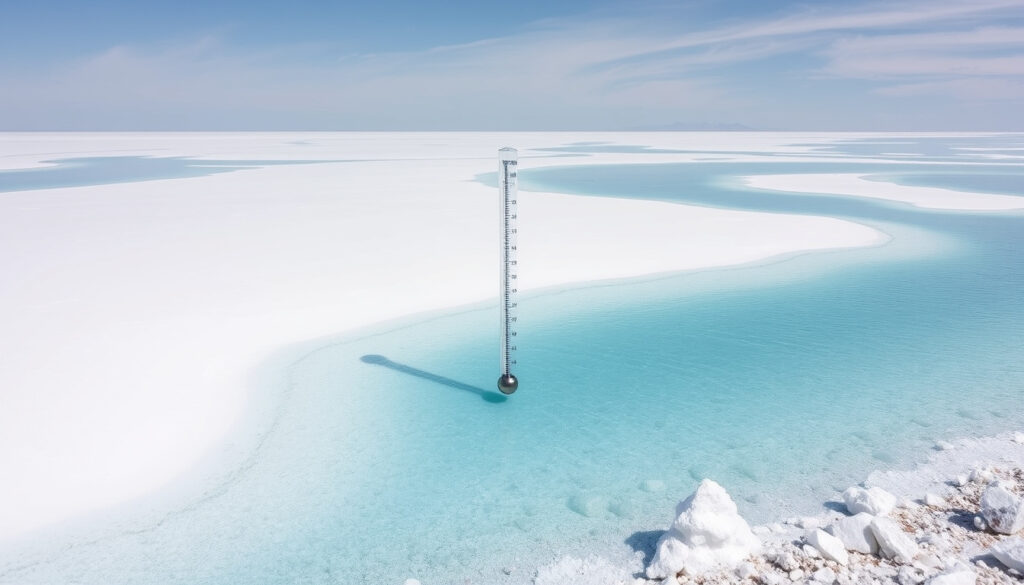
Sea Salinity: Definition, Measurement, and the World’s Saltiest Waters
You might think the Dead Sea is the saltiest water on Earth, but nature has a more extreme answer: Don Juan Pond in Antarctica at 40% salinity. This guide breaks down how sea salinity is measured and why it defines ecosystems.
Average ocean salinity: 35 parts per thousand (ppt) or 3.5% ·
Highest salinity of any water body: Don Juan Pond, Antarctica: 40% salinity (400 ppt) ·
Dead Sea salinity: approximately 34% (340 ppt) ·
Salinity of freshwater: less than 0.5 ppt
Quick snapshot
- Average ocean salinity is 35 ppt (Wikipedia)
- Dead Sea salinity is approximately 34% or 340 ppt (Introduction to Oceanography)
- Don Juan Pond has 40% salinity (400 ppt) (Introduction to Oceanography)
- Freshwater is defined as below 0.5 ppt (HORIBA)
- Exact salinity of some deep ocean brine pools remains poorly measured
- Long-term trends in ocean salinity due to climate change are still being studied
- Gaet’ale Pond’s reported 433 ppt has not been independently replicated in peer-reviewed research
- Salinity classification boundaries vary between sources (e.g., Coastal Wiki vs Wikipedia)
- Salinity measurement shifted from titration to conductivity in the mid-20th century (Frontiers in Marine Science)
- IAPSO Standard Seawater calibration became the global reference (UBC EOAS)
- Satellite sensors (SMOS, Aquarius) continue to map global salinity patterns
- Climate models project increased salinity contrast between wet and dry ocean regions
A quick reference table shows how salinity compares across different waters.
| Property | Value |
|---|---|
| Average ocean salinity | 35 ppt (3.5%) |
| Highest natural salinity | Don Juan Pond: 40% (400 ppt) |
| Dead Sea salinity | 34% (340 ppt) |
| Least saline sea | Baltic Sea: 0.5–1.5% (5–15 ppt) |
| Salinity unit | Parts per thousand (ppt) or parts per million (ppm) |
| Red Sea salinity | ~40 ppt (4%) |
| Freshwater threshold | < 0.5 ppt |
| Brackish water range | 0.5–30 ppt |
| Hyperhaline classification | > 65 PSU or > 300‰ depending on system |
| Seawater typical range | 33–38 ppt |
What sea has the highest salinity in the world?
The answer depends on whether you mean a connected sea or any water body. The Dead Sea is often cited with a salinity around 34% (340 ppt), making it nearly ten times saltier than the open ocean, according to Introduction to Oceanography (Roger Williams University). But the true champion sits in Antarctica: Don Juan Pond, which reaches 40% salinity (400 ppt) and remains liquid at temperatures far below freezing.
“The ocean is getting saltier in some regions and fresher in others,” NASA notes.
Which sea has the least salinity?
The Baltic Sea holds the title for the least salty sea, with salinity ranging from 0.5% to 1.5% (5–15 ppt). WorldAtlas notes that the Baltic, along with the Caspian Sea and many estuaries, falls into the brackish category — roughly between 0.5 g/L and 30 g/L. The Arctic Ocean also ranks low due to ice melt and river input, but it still averages around 30 ppt in most areas.
What is 10 times saltier than seawater?
The Dead Sea at 340 ppt is roughly 10 times saltier than the average ocean. But “10 times saltier” is almost a baseline for hypersaline waters. Gaet’ale Pond in Ethiopia has been reported at 433 ppt according to Introduction to Oceanography — that’s more than 12 times the ocean’s average. However, this measurement has not been independently replicated in peer-reviewed literature, so some uncertainty remains.
Which ocean has the highest salinity?
The Atlantic Ocean is the saltiest of the five major ocean basins. The Red Sea and Persian Gulf, both connected to the Indian Ocean via narrow straits, have the highest surface salinity among large connected bodies, around 40 ppt according to WorldAtlas. The Mediterranean Sea also ranks high due to evaporation exceeding precipitation, averaging about 38 ppt in its eastern basin.
The planet’s saltiest waters aren’t seas at all — they’re isolated ponds and lakes where evaporation dramatically outpaces freshwater input. Don Juan Pond at 400 ppt is 114 times saltier than the open ocean, yet it’s barely a puddle in the Antarctic dry valleys.
The implication: “salty” means very different things depending on whether you’re standing on a Baltic beach or beside a Antarctic brine pool. The gap between 0.5 ppt and 400 ppt is not a matter of degree — it’s a difference in kind, separating ecosystems that would collapse instantly if swapped.
What do you mean by 40% salinity?
40% salinity means that 40% of the water’s weight comes from dissolved salts — that’s 400 grams of salt per liter of water. To put that in perspective, if you filled a one-liter bottle with Don Juan Pond water, 400 milliliters of solid salt would be left if you boiled the water away. That’s roughly the same concentration as the brine used in commercial pickling.
What bodies of water have salinity near 40%?
Don Juan Pond in Antarctica is the only known natural water body with sustained 40% salinity. The Dead Sea, at 34%, is close but still significantly lower. Gaet’ale Pond in Ethiopia has been reported at 43.3%, but this is based on limited sampling. For comparison, typical table salt solution for cooking is around 6%, and the Dead Sea is already so dense that swimmers float effortlessly.
40% salinity is beyond the tolerance threshold for nearly all multicellular life. Only specialized extremophiles — certain bacteria and archaea — can survive in Don Juan Pond. This makes these waters natural laboratories for studying the limits of life on Earth and the potential for life on other planets.
The trade-off: these hypersaline environments are scientifically invaluable but ecologically barren. The same extreme conditions that preserve ancient microbial traces also mean nothing complex can live there.
What does 35% salinity mean?
This is where a unit confusion often trips readers up. 35% salinity — when you see it written this way — actually means 35 parts per thousand (ppt), or 3.5% by weight. The ocean contains about 35 grams of dissolved salt per liter of water. That’s roughly two tablespoons of salt dissolved into a quart of water. Wikipedia states this as the global average for open-ocean seawater, and it has been the standard reference point for oceanographers for over a century.
- 35 ppt = 3.5% by weight = ~35 grams of salt per liter
- The symbol ‰ (per mille) is often used instead of % to avoid confusion
- Practical Salinity Units (PSU) are numerically equivalent to ppt for most ocean waters
The catch: when you see a source say “35% salinity” without the per mille symbol, check the context. If they’re talking about the Dead Sea at “340%”, they almost certainly mean 340 ppt (34%). The difference between 3.5% and 40% is the difference between your kitchen sink and an Antarctic brine — make sure you’re comparing the same units.
What is the salinity of sea water?
Seawater salinity varies by location, depth, and season. The open ocean ranges from about 33 to 38 ppt, according to the University of Hawaiʻi at Mānoa. The map is not uniform: salinity peaks in subtropical evaporation zones (like the middle of the Atlantic) and drops near the equator and at high latitudes where rainfall and ice melt dilute the surface water.
“Salinity is computed from conductivity relationships involving temperature and pressure corrections,” according to the University of British Columbia’s oceanography handout (UBC EOAS).
What is the average salinity of the world’s oceans?
The global average is 35 ppt, a number that has held steady in oceanographic textbooks for generations. Wikipedia notes that this average masks significant regional variation. The North Atlantic averages closer to 37 ppt, while the North Pacific is around 32 ppt. These differences matter for ocean currents, climate, and marine biology.
The full comparison table reveals the immense range of salinities across the world’s waters.
| Water body | Salinity (ppt) | Category |
|---|---|---|
| Don Juan Pond | 400 | Hyperhaline (brine) |
| Gaet’ale Pond | 433 (reported) | Hyperhaline (brine) |
| Dead Sea | 340 | Hyperhaline |
| Great Salt Lake | ~310 | Hyperhaline |
| Red Sea | ~40 | Euhaline (seawater) |
| Mediterranean Sea | ~38 | Euhaline |
| Atlantic Ocean | ~37 | Euhaline |
| Global ocean average | 35 | Euhaline |
| Pacific Ocean | ~32 | Euhaline |
| Baltic Sea | 5–15 | Brackish (mesohaline) |
| Freshwater | < 0.5 | Oligohaline |
How is salinity measured?
Modern oceanography doesn’t boil samples anymore. Salinity is now measured primarily by electrical conductivity. Frontiers in Marine Science explains that practical salinity is derived from conductivity relationships involving temperature and pressure corrections. The process involves standardizing a salinometer with IAPSO Standard Seawater and measuring the conductivity ratio at a fixed temperature, as detailed in UBC’s Earth, Ocean and Atmospheric Sciences handout.
- Conductivity salinometers — most common method, accurate to ±0.001 ppt
- Titration — historical method using silver nitrate to precipitate chloride
- Satellite sensors — SMOS and Aquarius map salinity from space, but only penetrate the top centimeter
- Refractometer — field instrument that measures how light bends through water
Which sea has the least salinity?
The Baltic Sea is consistently cited as the world’s least salty sea. Its salinity ranges from 0.5% to 1.5% (5–15 ppt), depending on location and depth. WorldAtlas explains that the Caspian Sea, Baltic Sea, and many estuaries fall into the brackish category, roughly between 0.5 g/L and 30 g/L. The Baltic’s low salinity is caused by its limited connection to the North Sea, combined with massive freshwater inflow from over 200 rivers.
What causes low salinity in seas?
Three main factors drive low salinity: high freshwater input from rivers and precipitation, limited evaporation due to cold temperatures, and restricted connection to the open ocean. The Baltic has all three. The Arctic Ocean is another example — cold water and melting ice keep salinity lower than the global averages.
How does the Baltic Sea compare?
The Baltic is about 70 times less salty than the Dead Sea. Its surface waters in the Gulf of Bothnia can drop below 3 ppt — technically freshwater by some definitions. This extreme gradient within a single sea creates unique brackish-water ecosystems found nowhere else. Species from both freshwater and marine environments overlap in the Baltic, but neither thrives at full ocean strength.
Climate change is expected to intensify the salinity contrast: dry regions get saltier, wet regions get fresher. For the Baltic, increased rainfall could push salinity even lower, potentially shifting its ecological balance toward freshwater species.
The pattern: salinity extremes are driven by one ratio — evaporation divided by freshwater inflow. Where evaporation wins, you get hypersaline brines. Where freshwater wins, you get brackish seas. The open ocean sits in the middle, a Goldilocks zone that supports the vast majority of marine life.
Related reading: Kilimanjaro Peak: Height, Difficulty, and Safety · Grizzly Bear Facts: Weight, Height, Behavior & Safety
coastalwiki.org, worldatlas.com, mikegravel.org, weatherology.com, en.wikipedia.org, japanpulse.net
Frequently asked questions
What is the saltiest ocean in the world?
The Atlantic Ocean is the saltiest of the five major ocean basins, with an average salinity around 37 ppt in its subtropical gyres. The Red Sea and Mediterranean Sea, though not separate oceans, have even higher surface salinity (~38–40 ppt) due to intense evaporation.
Why is the Red Sea so salty?
The Red Sea sits in a hot, arid region where evaporation rates are extremely high and rainfall is minimal. It also has limited water exchange with the Indian Ocean through the narrow Bab-el-Mandeb strait. These factors concentrate dissolved salts, giving the Red Sea a surface salinity of about 40 ppt.
How does salinity affect marine life?
Salinity determines osmotic pressure — the balance of water and salts inside and outside an organism’s cells. Most marine species survive within a narrow salinity range (typically 30–40 ppt). When salinity drops below 5 ppt or rises above 50 ppt, the number of species that can survive drops dramatically. Only specialized extremophiles live in hypersaline environments like the Dead Sea.
What is the salinity of the Caspian Sea?
The Caspian Sea is actually a lake, not a sea, and its salinity averages about 12.8 ppt in its middle basin — roughly one-third the salinity of the open ocean. The northern Caspian can drop below 1 ppt due to Volga River inflow, while the southern basin reaches around 13 ppt.
Can you drink sea water?
No. Seawater at 35 ppt contains far more salt than the human kidney can process. Drinking seawater would force your body to excrete more water than you consumed to eliminate the excess salt, leading to dehydration. This is why survival guidelines expressly forbid drinking seawater even in extreme situations.
What is the difference between salinity and salt concentration?
Salinity specifically refers to the total dissolved inorganic salts in water, while salt concentration can refer to specific ions (like sodium or chloride) or total dissolved solids including organic matter. In practice, oceanographers measure salinity as a derived value from conductivity, while “salt concentration” is a more general term used in chemistry and industry.
For a reader trying to understand sea salinity, the key takeaway is simple: unit confusion is the biggest trap. When a source says “the Dead Sea is 34% salt,” they almost certainly mean 34% by weight (340 ppt) — not the much lower percentage that a quick glance might suggest. Always check whether a number is in ppt (parts per thousand) or true percentage, because the difference between 3.5% and 35% is the difference between the Atlantic Ocean and a place where nothing alive swims.
More related posts
 Bobby Norris: TOWIE Exit, Feud, and Surgery Update
 Darren Till: UFC Release, Next Fight, Record & Personal Life
 Chris Mason: BBC Political Editor Salary, Age, Wife and Biography
 Guru Nanak: Life, Teachings, and Modern Debates
 Dom Joly: School, Career, and the Bin Laden Connection
 Reena Virk Case: Warren Glowatski Now, Kelly Ellard Appeal
 Kenny Everett: Life, Career, and Controversies
 Pat Cummins IPL 2026: Injury Update, Return Date & Net Worth